

Attention Is Cheap to Chase. Trust Is Expensive to Earn.
AI can make outreach, content, and distribution abundant. It cannot make a buyer trust you. Part 2 of Infin8's pull-marketing series examines what businesses have to earn before the first sales conversation.
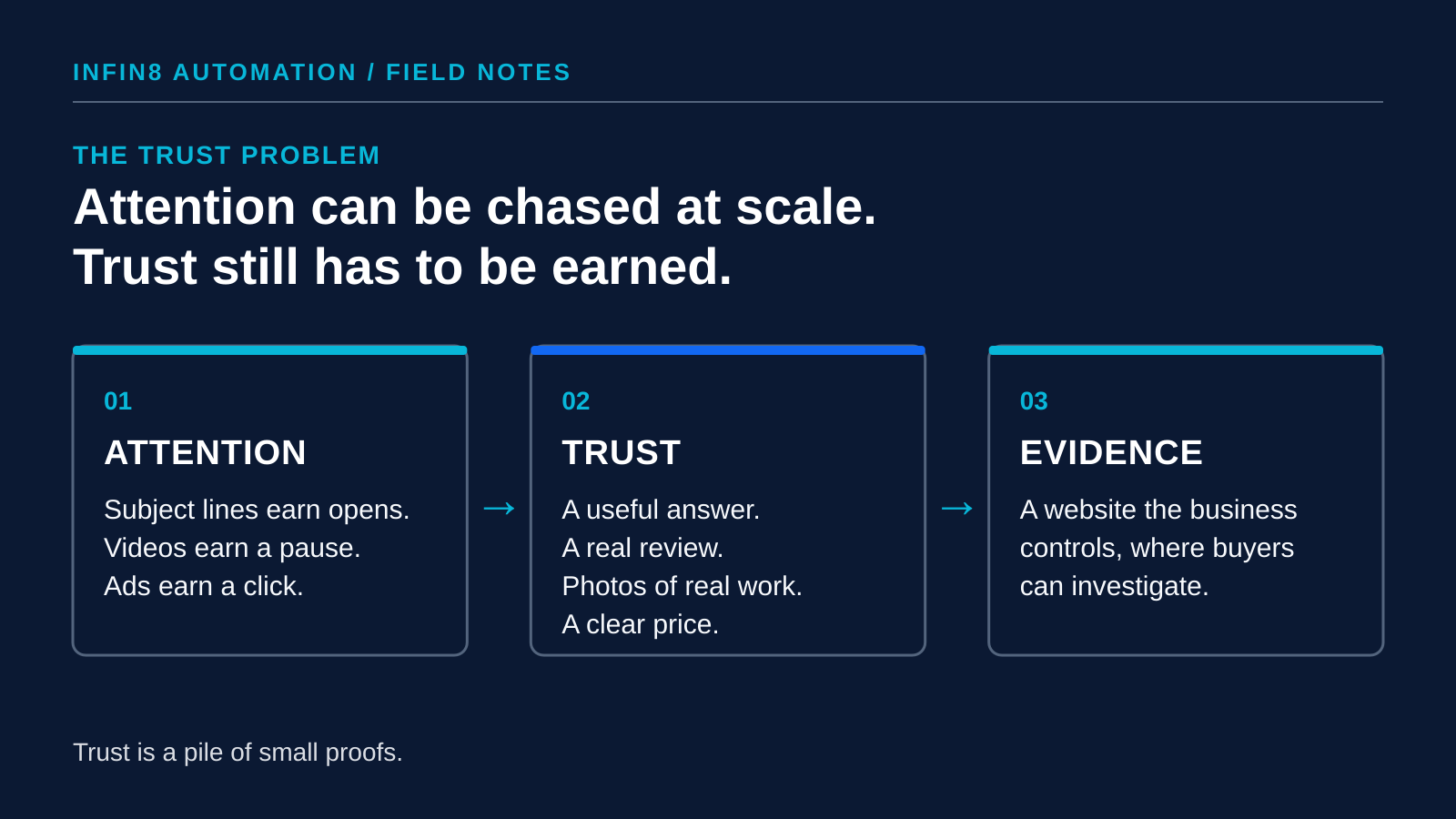
THE TRUST PROBLEM
Attention can be chased at scale. Trust still has to be earned.
- 01ATTENTIONSubject lines earn opens. Videos earn a pause. Ads earn a click.
- 02TRUSTA useful answer. A real review. Photos of real work. A clear price.
- 03EVIDENCEA website the business controls, where buyers can investigate.
Trust is a pile of small proofs.
Attention was only the first problem
Part 1 of this series argued that when every business can push more messages, pushing itself becomes less valuable. AI makes competent copy inexpensive. Automation makes distribution inexpensive. The buyer's attention does not become more abundant just because our ability to chase it does.
But winning a moment of attention is not the same thing as winning consideration. A subject line can earn an open. A short video can earn a pause. An ad can earn a click. None of those actions requires the buyer to believe you.
That is the harder problem. Attention can be rented, bought, optimized, automated, and chased. Trust accumulates much more slowly.
Buyers are forming opinions before the conversation
6sense's 2025 study of nearly 4,000 B2B buyers found that 95% of winning vendors were already on the buyer's Day One shortlist. Buyers reported initiating 79% of first seller engagements, and 94% said they had ordered their shortlist by preference before engaging sellers.
Those numbers come from B2B purchases, many larger and more complex than the decisions a local or small-business customer makes. They should not be pasted indiscriminately onto every buying journey. But the behavior underneath them matters: people can investigate a business before the business knows they exist.
A buyer can inspect your site, reviews, examples, pricing clues, videos, social presence, competitors, and increasingly AI-generated summaries before filling out a form or answering a sales call. By the time the conversation begins, the first impression may be old news.
AI makes looking credible easier
This is where the same technology that makes distribution easier creates another problem. AI can help almost anyone produce polished language, clean graphics, a professional-looking website, and a steady stream of posts.
That is useful. We use those capabilities ourselves. But polish becomes less informative when everyone can manufacture it.
The trust question moves underneath the presentation. Have you demonstrated that you understand the problem? Have you shown real work? Are your claims specific enough to inspect? Do your explanations survive scrutiny? Can a customer tell what happens after they say yes?
A company does not become trustworthy because its content looks expensive. It becomes easier to trust when the evidence behind the presentation is coherent.
Trust is a pile of small proofs
There is rarely one magical trust asset. It is usually an accumulation: a useful answer to a difficult question, a review that sounds like an actual customer, a photograph of real work, a clear explanation of price, a case where something went wrong and was fixed, a consistent business profile, a service page that explains the process without hiding behind slogans.
Even saying when your service is not the right answer can be evidence. A business willing to narrow the sale demonstrates that it understands the decision rather than merely wanting the transaction.
The pieces reinforce one another. The article makes the review more believable. The review makes the service page less abstract. The service page makes the sales conversation easier. The sales conversation confirms what the buyer already found.
The website becomes the evidence room
Social platforms are excellent distribution systems. They are not the place I want the entire memory of a business to live.
A useful post should be able to lead somewhere deeper: an article, service explanation, comparison, case study, FAQ, demonstration, or next step on a property the business controls. Over time that owned library becomes an evidence room for customers who want to investigate before they commit.
That matters even as AI changes search behavior. Pew Research Center observed that Google users clicked traditional results in 8% of visits with an AI summary, compared with 15% of visits without one. The study does not prove the AI summary caused the difference. It does show why depending on a click as the only measure of discovery is increasingly incomplete.
Your expertise may be encountered through search, social, reviews, AI assistants, referrals, or a link somebody sends privately. The job is to leave enough useful, consistent evidence that wherever the investigation begins, there is something substantial to find.
Do not confuse volume with familiarity
Posting constantly can make a company visible. It can also make the company easier to ignore.
Belkins analyzed more than 7.5 million cold emails sent across its client campaigns in 2025 and reported a 0.45% average reply rate using replies divided by total emails sent. Belkins explicitly notes that this denominator differs from its older studies, so the number should not be used to manufacture a dramatic historical collapse. Within the 2025 dataset, reply rates averaged 0.50% in the first half and 0.40% in the second.
The lesson is not that outbound is dead. It is that volume does not exempt a message from having to matter. Familiarity built from repeated noise is not the same thing as trust built from repeated usefulness.
Publish what only your business can know
The strongest raw material is usually sitting inside the company already: the question customers ask before buying, the estimate that needs an explanation every time, the mistake an experienced technician notices immediately, the objection that sounds reasonable but is based on a bad assumption, the tradeoff nobody explains until after the sale.
AI can help extract, research, organize, edit, distribute, and measure that knowledge. It should make the expertise easier to publish, not replace the expertise with generic filler.
That distinction is going to matter more as competent-looking content becomes nearly free. If the internet fills with acceptable answers, firsthand knowledge becomes more valuable, not less.
Trust still is not the finish line
This series started with a simple observation: when everyone can push, pushing loses value. The next advantage is becoming worth finding and worth believing.
But there is a trap waiting on the other side. A business can become useful, credible, and discoverable and still lose the customer. Someone can read three articles, check the reviews, visit the service page, and disappear because the next step is confusing, the response is slow, the follow-up never happens, or nobody recognizes what the buyer was trying to do.
Trust creates the opportunity. A system has to capture it.
That is Part 3: Build the Pull Machine.
Questions this article answers
Why is trust becoming more important in AI-driven marketing?
AI lowers the cost of producing polished messages and content, so presentation alone carries less information about expertise. Specific evidence, firsthand knowledge, reviews, examples, and consistent customer experiences become more important signals.
Does pull marketing mean stopping outbound marketing?
No. Outbound can still work. The argument is that outbound becomes stronger when a prospect can independently investigate the business and find credible evidence behind the message.
What should a small business publish to build trust?
Start with material only the business can answer well: real customer questions, tradeoffs, pricing explanations, demonstrations, case studies, mistakes, comparisons, reviews, and clear descriptions of what happens next.
Sources and further reading
See where prospects are getting lost before you spend more to get them.
Infin8's $279 Customer Path Review maps the path from first click to follow-up and identifies the highest-value fixes.