

When Everyone Can Push, Pushing Loses Value
As cold outreach gets crowded and AI changes discovery, businesses need useful answers, real proof, and a website buyers can trust before the first sales call.
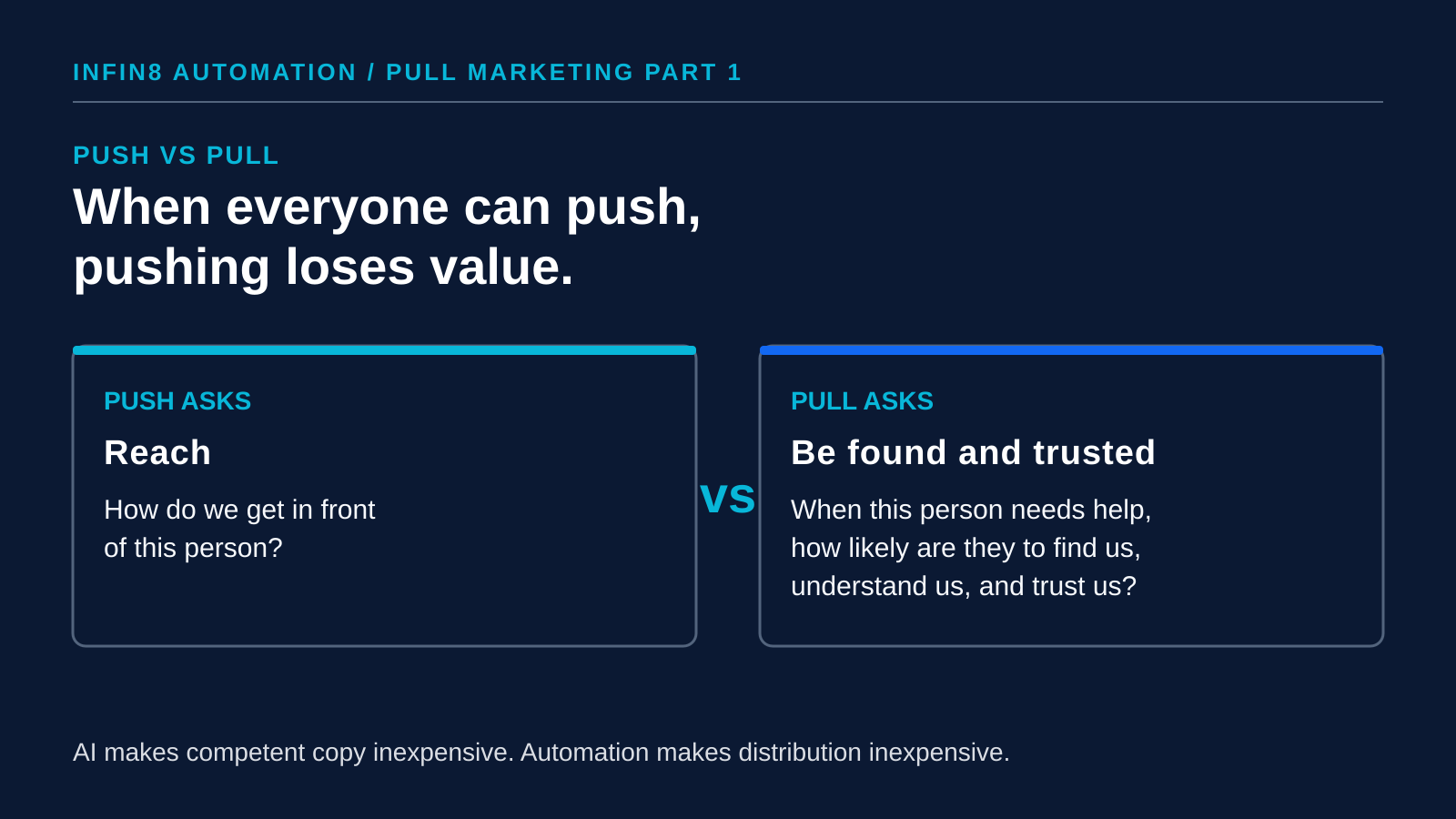
PUSH VS PULL
When everyone can push, pushing loses value.
- PUSH ASKSReachHow do we get in front of this person?
- PULL ASKSBe found and trustedWhen this person needs help, how likely are they to find us, understand us, and trust us?
AI makes competent copy inexpensive. Automation makes distribution inexpensive.
The question behind the drop
A friend of mine sends hundreds of thousands of outbound emails every month. Recently, he told me some of the numbers he watches had fallen dramatically over six months. I take that seriously. His campaign data is not in this article, though, and I cannot turn one operator's experience into an industry-wide claim or blame AI for the change.
It did make me ask a larger question: what happens when nearly every business can produce and send more messages, but the person receiving them has no more time to spare?
When everyone can push, pushing loses value.
AI makes competent copy inexpensive. Automation makes distribution inexpensive. A small company can run campaigns that once required a full marketing department. The same tools are available to its competitors, to new agencies, and to people who have only just decided to call themselves agencies.
None of that creates another hour in a buyer's day. It does not create another inbox. It does not manufacture trust.
The issue is larger than cold email
Cold email is not dead. But its economics deserve a clear-eyed look. Belkins analyzed more than 7.5 million cold emails sent in its client campaigns during 2025. The average reply rate was 0.45%; the first half averaged 0.50%, compared with 0.40% in the second half. That is pressure inside one provider's campaigns, not a controlled measurement of the entire market or an explanation of my friend's last six months.
Belkins also changed its measurement method from replies per unique opener to replies per total email sent. Comparing its newer rate with its older reports as if they used the same denominator would create a false collapse. Open tracking has its own reliability problems. Deliverability, sender reputation, audience selection, list quality, seasonality, and repeated contact may all change the outcome.
The useful question is not whether a dramatic statistic makes a good headline. It is what a business should build when reaching someone becomes cheap and being worth their attention remains hard.
The buyer can learn before speaking to you
A prospect can read reviews, watch demonstrations, compare alternatives, ask an AI assistant to explain unfamiliar terms, and decide which questions to ask a seller. The first sales call can arrive after a preference has formed.
6sense's 2025 survey of nearly 4,000 B2B buyers found that the company ultimately chosen was on the buyer's initial shortlist 95% of the time. Buyers actually contacted sellers earlier than the prior year in that study; the result is not that salespeople have disappeared. It is that a business often earns its place in the conversation before the conversation begins.
AI is also changing the path from a question to a website visit. Pew's observed Google browsing study found a traditional result was clicked in 8% of searches with an AI summary, versus 15% without one. Those searches may differ in other ways, so that comparison alone does not establish causation. It does challenge the assumption that every useful discovery begins with a click to your site.
Your website still matters. So do clear service information, original examples, reviews, useful video, and consistent business profiles. They give buyers—and the systems helping those buyers—something substantial to evaluate.
When every competitor has the same megaphone
Imagine ten businesses selling similar services. Give each AI copy tools, a prospect database, a CRM, a landing-page builder, and automated sequences. Every one of them can send more. None of them has gained exclusive access to the customer's attention.
The natural response is to increase volume: more email, more social messages, more ads, more follow-up. The recipient experiences that response as noise. The next generic message has to compete with all the others created by the same cheap machinery.
This is why output volume by itself is such a weak strategy. What becomes valuable is specific evidence: a real demonstration, a candid explanation of price, a useful comparison, an honest review, a case that shows what went wrong and how it was fixed.
Pull changes the question
Push asks: How do we get in front of this person?
Pull asks: When this person needs help, how likely are they to find us, understand us, and trust us?
That question changes the job of an article. It changes the job of a social post. The post is a doorway into a deeper answer on a site the business controls. A business profile helps someone verify the company locally. A video shows the work. Reviews offer independent perspective. A useful service page explains what happens next.
In August, I argued that every business is becoming a media company. I did not mean a plumber needs to become an influencer. I meant that publishing what a business actually knows is becoming part of how it earns trust. This article is the next question: why is that ability becoming more valuable now?
Consider the questions customers ask before they buy: What does it cost? What can I handle myself? How long will it take? What should I compare? What happens if I wait? When should I choose a competitor or a different solution?
Those are buying questions. Answering them with firsthand knowledge lets a prospective customer encounter your thinking before they encounter your sales process.
Generic content is cheap too
AI can produce a hundred bland articles as easily as it can produce a hundred bland emails. Publishing more interchangeable paragraphs will not make a company trustworthy.
Show the actual work. Explain the tradeoffs. Tell people when they do not need the service you sell. Use a photograph or illustration that shows the subject being discussed rather than decoration with no editorial job. If a diagram makes a comparison clearer, make its labels readable and place it where the reader can inspect it.
That is a higher standard than simply posting every day. It is also material a buyer can use.
Build something people can pull from you
The raw material is already inside the business: sales calls, estimates, support tickets, objections, successful projects, mistakes, repeated explanations, and informed opinions.
Capture the strongest questions. Give each substantial answer a durable home on your site. Connect that answer to platform-native posts, useful video, reviews, and a current business profile. Make the next step clear when someone is ready to ask for help. Then respond when they do: creating demand and capturing it are separate jobs.
This does not require abandoning outbound. A relevant email can work. Paid search can meet an active need. Partnerships, referrals, and thoughtful follow-up still matter. All of them benefit when someone can look up the business and find proof behind the promise.
The cost of pushing messages toward people keeps falling. The value of becoming the company people seek out and learn from keeps rising.
When everyone can push, that difference starts to matter.
Questions this article answers
Is cold email dead?
No. The argument is not that outbound stops working. It is that cheaper, easier outreach creates more competition for a fixed amount of buyer attention, which raises the value of trust, proof, and useful owned content.
What is pull marketing in this context?
Pull marketing means building useful, discoverable evidence and answers so buyers can find, understand, and trust the business when they are actively researching a problem.
Does AI make websites less important?
No. AI changes how people discover information, but websites, service pages, reviews, examples, and other owned proof still give buyers and AI-assisted discovery systems substantive material to evaluate.
Sources and further reading
See where prospects are getting lost before you spend more to get them.
Infin8's $279 Customer Path Review maps the path from first click to follow-up and identifies the highest-value fixes.