The Influencer Degree Is Not the Story. Every Business Is Becoming a Media Company
Universities are building degrees for creators, but the larger shift is bigger than influencer culture: publishing, audience building, and digital authority are becoming core business infrastructure.
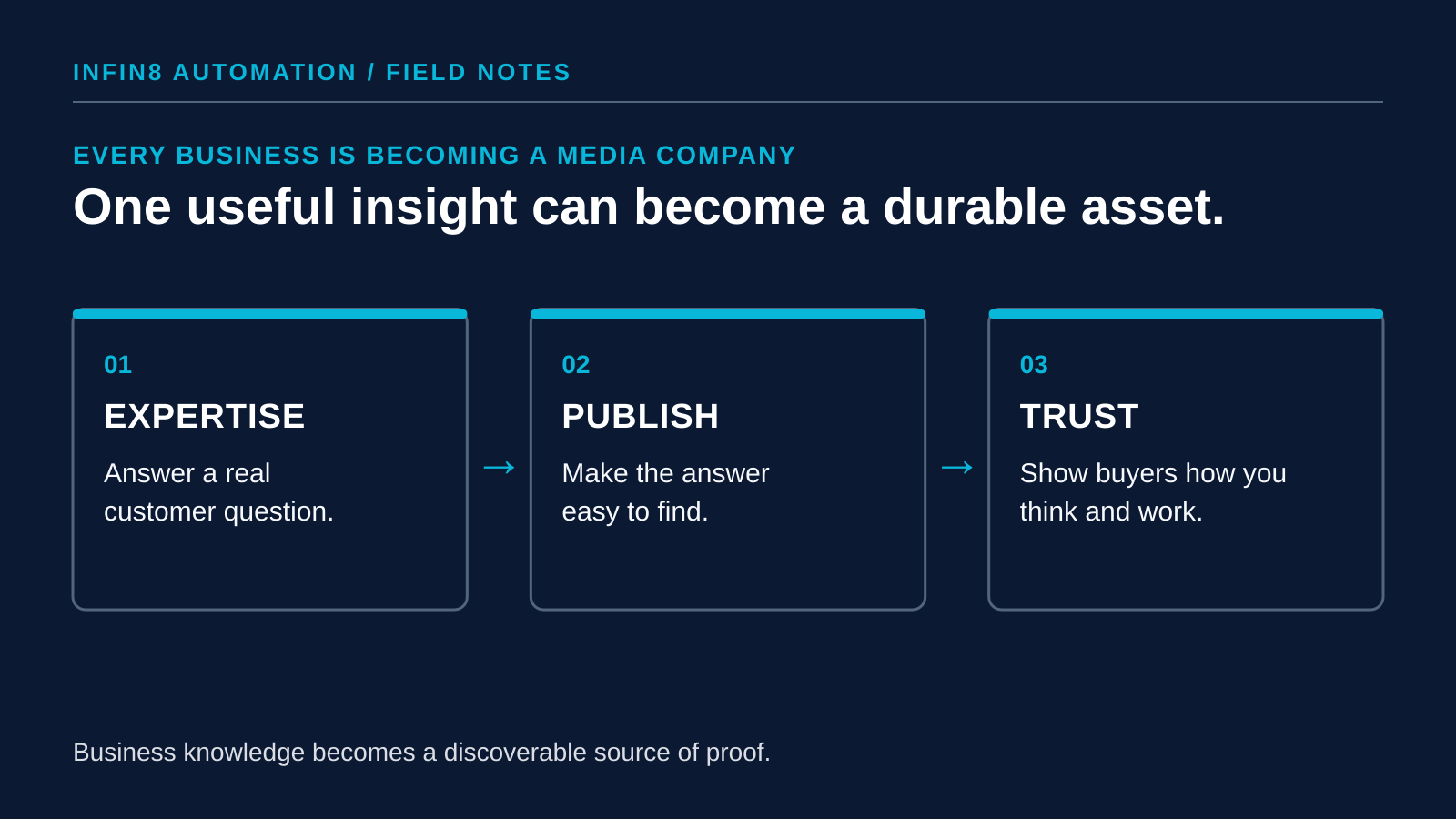
EVERY BUSINESS IS BECOMING A MEDIA COMPANY
One useful insight can become a durable asset.
- 01EXPERTISEAnswer a real customer question.
- 02PUBLISHMake the answer easy to find.
- 03TRUSTShow buyers how you think and work.
Business knowledge becomes a discoverable source of proof.
The headline is easy to mock
Arizona State University is now offering a Bachelor of Arts in Content Creation. Syracuse University is launching a creator economy minor. The predictable reaction is already here: people are laughing at the idea of paying college tuition to learn how to become an influencer. That reaction is understandable. Nobody needed a diploma to start a YouTube channel, build a TikTok following, launch a newsletter, or become the next breakout personality online.
But mocking the degree misses the larger shift. Universities are not creating these programs because posting videos suddenly became academically profound. They are responding to a structural change in how attention, trust, distribution, and commerce now work. The modern creator is not merely a performer. A serious creator is a one-person media company, marketing department, sales channel, production studio, community manager, and product incubator.
The real story is not that young people want to become influencers. The real story is that the skills once associated with influencers are becoming basic operating skills for almost every company.
Universities are reacting to a real economy
Arizona State University's program is housed inside the Walter Cronkite School of Journalism and Mass Communication. Its curriculum emphasizes content planning, video and podcast production, social media strategy, audience analytics, integrated communication, and personal branding. Syracuse is taking an explicitly interdisciplinary approach by combining communications, entrepreneurship, monetization, strategic partnerships, and customer acquisition.
That matters because the creator economy is no longer a strange side hustle at the edge of the internet. Goldman Sachs Research estimated that the market could grow from roughly $250 billion to $480 billion by 2027. The Interactive Advertising Bureau reported that United States creator advertising spending reached $37 billion in 2025 and was growing substantially faster than the broader media industry.
When that much money moves into a category, schools build programs, companies build departments, investors build funds, and workers build careers around it. The academic response may be late, imperfect, and expensive, but it is not irrational. The economy has already changed.
The degree still does not guarantee the dream
Here is the uncomfortable part. Training for the creator economy is legitimate. Assuming a degree will turn someone into a successful influencer is not.
Goldman Sachs estimated that only about four percent of global creators earn more than $100,000 per year. Brand deals account for about seventy percent of creator revenue, which means much of the industry remains dependent on advertisers, platforms, algorithms, and shifting cultural attention. A creator can build an audience for years and still discover that reach does not automatically become durable income.
That makes an influencer degree similar to an acting degree, a music degree, or an entrepreneurship degree. The education can improve the craft, expose the student to useful tools, create relationships, and shorten the learning curve. It cannot manufacture charisma, timing, audience fit, discipline, commercial judgment, or luck.
The best version of these programs will prepare students for dozens of roles beyond personal fame: content strategist, producer, editor, social media manager, audience analyst, brand manager, community operator, podcast producer, creator partnership manager, and digital entrepreneur. The worst version will sell students a glamorous lottery ticket financed with debt.
A creator is a business model, not a job title
The creator economy becomes easier to understand when we stop treating 'creator' as a job title. It is a business model built around producing useful or entertaining intellectual property, earning attention, developing trust, and converting that trust into economic activity.
Sometimes the conversion is direct: advertising revenue, subscriptions, sponsorships, memberships, merchandise, courses, events, or digital products. Sometimes the content supports a different business entirely. A lawyer publishes explanations that generate consultations. A party rental company publishes planning guides that generate quote requests. An automotive shop publishes repair education that generates appointments. A software company publishes workflows that generate trials.
In each case, the content is not merely content. It is distribution. It is proof. It is the beginning of a customer relationship.
That is why the smartest creators eventually build products, services, communities, and owned channels. They understand that a million views rented from a platform can be less valuable than a thousand people on an email list who trust them and have a reason to buy.
Every business is becoming a media company
For most small businesses, the phrase 'media company' sounds absurd. A local operator does not want to become Netflix. The owner wants the phone to ring, the calendar to fill, and revenue to become more predictable.
But the business is already being judged like a publisher. Buyers search before they call. They compare websites, reviews, videos, social profiles, articles, photos, frequently asked questions, and evidence of expertise. They ask Google, ChatGPT, and other artificial intelligence systems to recommend providers and explain their options. Before the owner ever speaks to the prospect, the prospect has consumed a small body of media about the company.
A business that does not publish leaves its reputation to directories, reviewers, competitors, and whatever stale fragments a search engine can assemble. A business that publishes consistently can explain what it does, whom it serves, how its process works, what mistakes buyers should avoid, and why its experience matters.
That does not mean every owner needs to dance on TikTok. It means every serious business needs a system for turning what it knows into material that customers and machines can understand.
Artificial intelligence makes publishing cheaper and authority more valuable
Artificial intelligence has dramatically reduced the cost of research, drafting, editing, transcription, repurposing, design, and production. One knowledgeable operator can now create the output that once required a writer, editor, researcher, designer, and distribution assistant.
That will produce an ocean of average content. It will not eliminate the value of original knowledge. It will increase it.
When everyone can generate competent words, the advantage shifts toward firsthand experience, specific evidence, original frameworks, strong opinions, useful examples, proprietary data, and a recognizable point of view. Google has continued adjusting its artificial intelligence search products to highlight original sources, cited material, and distinct perspectives. Buyers are also becoming better at recognizing generic sludge.
The winning formula is not artificial intelligence replacing the expert. It is artificial intelligence helping the expert publish more of what only that expert knows.
Content without a revenue system is expensive theater
This is where most creator programs, marketing agencies, and business owners go wrong. They focus on production and stop at publication.
A video gets views. An article ranks. A post receives comments. Everyone celebrates the dashboard. Then nothing happens because there is no clear offer, no useful next step, no lead capture, no Customer Relationship Management system, no follow-up, no sales process, and no attribution.
Attention alone is not a business outcome. It is raw material.
A functional content system must answer five questions. Who is the content for? What problem does it help solve? What action should the right person take next? What happens after that action? How will the business know whether the content contributed to revenue?
Without those answers, content becomes a recurring expense that makes the company look busy. With those answers, one useful article can support search visibility, sales conversations, email campaigns, social posts, proposals, onboarding, and artificial intelligence discovery for years.
The authority engine is the missing layer
The opportunity is not to create more disconnected posts. It is to build an authority engine.
An authority engine starts by extracting the real knowledge inside the business: customer questions, owner opinions, sales objections, process explanations, case studies, mistakes, comparisons, pricing logic, and industry changes. That knowledge is organized into topics tied to actual buyer intent.
The system then turns each core idea into a durable article, supporting pages, short-form posts, video scripts, email content, and sales assets. Every piece points toward an appropriate next step. Leads are captured, routed, followed up with, and measured. Strong content is updated and expanded instead of abandoned after one week.
This is the difference between 'doing content' and building business infrastructure. The first produces a feed. The second produces a compounding library of expertise connected to a customer path.
Small businesses have an unfair advantage they rarely use
Large companies have budgets, teams, and brand awareness. Small businesses have something the larger companies often cannot manufacture: proximity to the customer.
The owner hears the real questions. The technician sees the recurring mistakes. The salesperson knows why deals stall. The dispatcher knows what emergencies sound like. The team understands local conditions, strange edge cases, and the language customers actually use.
That information is content gold. Yet most of it disappears into phone calls, text messages, estimates, and conversations that are never captured.
A small company that records and organizes those insights can publish material more specific and useful than a national competitor's polished but generic marketing. Artificial intelligence makes the capture and production process affordable. The remaining requirement is a disciplined system that preserves the company's real voice instead of sanding it down into corporate mush.
What a serious creator education should actually teach
A credible creator curriculum should teach production, but production is only one layer. Students also need positioning, audience research, offer design, sales, intellectual property, contracts, disclosure rules, analytics, platform risk, cash flow, taxation, project management, and business operations.
They should learn the difference between followers and customers, reach and trust, rented distribution and owned distribution, a viral spike and a durable asset. They should understand how to build an email list, negotiate a brand agreement, price a service, protect their work, measure conversion, and survive when a platform changes its algorithm.
Most importantly, they should leave with a portfolio and a functioning commercial system, not merely a transcript. Syracuse's inclusion of monetization, partnerships, customer acquisition, and entrepreneurship points in the right direction. Arizona State University's emphasis on measurable audience growth is useful, but audience growth must be connected to value creation and business fundamentals.
The goal should not be to graduate with the title 'influencer.' The goal should be to graduate capable of building and operating modern distribution.
What this means for the next generation of workers
Young people are not foolish for noticing that traditional career paths feel less secure. Confidence in higher education has fallen sharply, and Gallup found in July 2026 that forty-six percent of Americans expect artificial intelligence to make college degrees less important over the next five years. At the same time, younger adults increasingly receive information, education, and recommendations from individual online personalities rather than only from institutions.
The attraction of the creator path is obvious. It appears to offer autonomy, ownership, creative expression, flexible work, and unlimited upside. The danger is that social platforms display the winners constantly and hide the enormous population working for little or nothing.
The most resilient path is not chasing fame as the product. It is learning how to earn attention and then attach that attention to a useful skill, service, product, community, or business. Fame can disappear. Capability and owned infrastructure are harder to take away.
The bigger story
The influencer degree is an interesting headline. It is not the transformation.
The transformation is that publishing, audience building, and digital trust are becoming core business functions. Every company now competes in an information environment shaped by search engines, social platforms, creators, reviews, and artificial intelligence answers. The companies that consistently explain, teach, demonstrate, and prove will be easier to discover and easier to trust.
This is not a command for every business owner to become a full-time personality. It is a command to stop treating expertise as something that should remain trapped inside the owner's head.
At Infin8 Automation, the point is not to create content for the sake of feeding platforms. The point is to turn business knowledge into discoverable authority, connect that authority to a clear customer path, automate the follow-up, and measure whether it produces revenue.
Content is not the final product. The final product is a business that can repeatedly convert what it knows into trust, demand, and customers.
That is the larger American dream hiding behind the influencer headline. Not everyone becomes famous. Every capable person and every credible business gains the power to publish, distribute, and build an audience without asking a gatekeeper for permission. The winners will be the ones who connect that power to something real.
Sources and further reading
- Yahoo / CNN: Influencing looks like the new American dream for young people
- Arizona State University: Bachelor of Arts in Content Creation
- Arizona State University Senate: Approval of the Content Creation degree
- Syracuse University: Creator Economy minor
- Goldman Sachs Research: The creator economy could approach $480 billion by 2027
- Interactive Advertising Bureau: 2025 Creator Economy Ad Spend and Strategy Report
- Gallup: Confidence in U.S. Higher Education Slips Back Slightly
- Pew Research Center: News Influencers Fact Sheet
- Google: New ways to find original content in Artificial Intelligence Search
See where prospects are getting lost before you spend more to get them.
Infin8's $279 Customer Path Review maps the path from first click to follow-up and identifies the highest-value fixes.