The New Logic of Power: Why the World Is Becoming Too Expensive to Conquer
Iran, Hormuz, China, Russia, artificial intelligence, and a stranger global equilibrium: what happens when nobody can dominate everyone else, but everyone can make domination catastrophically expensive?
THE NEW LOGIC OF POWER
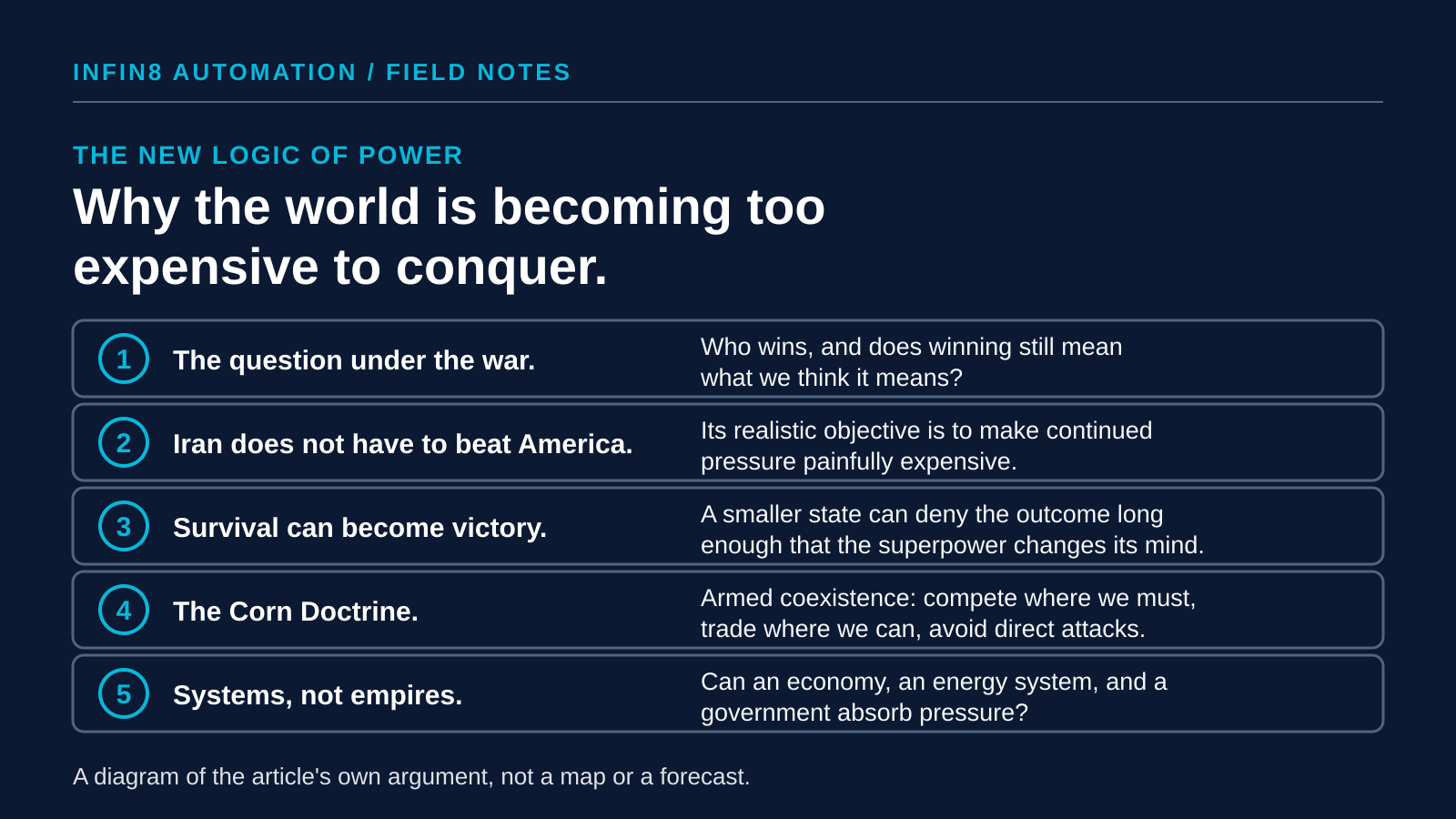
Why the world is becoming too expensive to conquer.
- 1The question under the war.Who wins, and does winning still mean what we think it means?
- 2Iran does not have to beat America.Its realistic objective is to make continued pressure painfully expensive.
- 3Survival can become victory.A smaller state can deny the outcome long enough that the superpower changes its mind.
- 4The Corn Doctrine.Armed coexistence: compete where we must, trade where we can, avoid direct attacks.
- 5Systems, not empires.Can an economy, an energy system, and a government absorb pressure?
A diagram of the article's own argument, not a map or a forecast.
The question hiding underneath the war
The obvious question in a war is who wins. The more interesting question is whether winning still means what we think it means.
The United States can destroy extraordinary amounts of military capability. Iran can impose extraordinary costs without needing to defeat the United States in a conventional war. China and Russia can support a rival system without necessarily wanting to fight America's military directly. Gulf states can depend on American security while simultaneously trading with China and negotiating with Iran. Everyone can be an adversary in one column and a business partner in another.
That produces a world that looks less like a chessboard and more like a wiring diagram drawn by somebody after three espressos. The alliances overlap. The incentives contradict one another. The weapons are powerful enough to make total victory dangerous. The economies are connected enough to make total separation expensive.
The central thesis of this piece is simple: the future may not belong to the strongest country. It may belong to the countries best able to make themselves too expensive to defeat.
Iran does not have to beat America
This is the part that changes the whole frame. Iran does not need to sink the United States Navy, occupy Washington, or win a conventional military contest. That is not the victory condition available to it.
Its more realistic objective is to make continued pressure painfully expensive. Geography gives it leverage. The Strait of Hormuz has carried roughly one-fifth of global oil supplies in normal conditions, and the current conflict has repeatedly demonstrated how quickly attacks, blockades, insurance risk, and shipping disruption can move through energy markets. In September, renewed attacks on shipping and Saudi energy infrastructure again pushed the Gulf toward a wider economic crisis while diplomacy over Hormuz stalled.
That is asymmetric power. The weaker military actor does not need to dominate the stronger one. It needs to possess enough leverage that the stronger one starts asking whether the next month of victory is worth the price.
That principle extends far beyond Iran. A smaller country can build missile forces, drones, cyber capability, hardened infrastructure, proxy relationships, difficult terrain, financial workarounds, and political endurance. None of those tools makes it stronger than a superpower in the traditional sense. Together they can make conquest a terrible business proposition.
Taking the capital is not the same as conquering the country
Modern military history keeps teaching the same lesson and governments keep discovering exciting new ways to relearn it.
Destroying an organized military is one problem. Taking airports, ports, government buildings, communications nodes, and major roads is another. Controlling a population after the old state collapses is a third problem, and it is usually the one that eats the calendar.
Once a conventional army fragments, the occupier inherits an ugly inversion of advantage. The invader has better aircraft, intelligence, logistics, satellites, armored vehicles, and communications. The insurgent has the ability to look ordinary. A mechanic can become a fighter at night. A warehouse can become an arms cache. A civilian truck can move supplies. A political grievance can recruit the next generation faster than an army can arrest the last one.
The invading power has to protect everything it captures. Roads. Power plants. Ports. Government offices. Oil facilities. Bridges. Prisons. Supply lines. Hospitals. Borders. Convoys. Airports. Every successful advance creates another object that now requires security.
This is the occupation paradox: the more territory you successfully take, the more territory you are responsible for keeping stable.
The new definition of victory may simply be survival
For a superpower, victory traditionally implies imposing an outcome. For a smaller state, victory can mean denying that outcome long enough that the superpower changes its mind.
That is a much cheaper standard. The stronger country may need to maintain political support, military readiness, alliance cohesion, economic stability, shipping security, and public patience simultaneously. The weaker country may need only to keep enough capability alive to remain dangerous.
Survival can become victory.
That is why a country can lose aircraft, bases, senior commanders, economic output, and territory and still claim strategic success if the adversary eventually leaves without achieving its political objective. It sounds backwards until you remember that wars are fought for political outcomes, not scoreboards.
A military can win ninety-nine engagements and still fail strategically if the hundredth consequence is that the political objective becomes unaffordable.
China and Russia do not need to form a comic-book supervillain team
The cleanest version of the future is tempting because humans like teams. America and Europe on one side. China, Russia, Iran, and everybody angry at the West on the other. New Cold War. Two blocks. Pick a jersey.
Reality is developing into something messier.
China wants a larger role for the BRICS grouping and is pushing deeper cooperation in trade, finance, technology, and artificial intelligence. Russia openly argues for a more multipolar order. Iran is now inside that larger BRICS structure. Yet the same grouping can call for de-escalation in the Middle East because its members do not share identical interests. The United Arab Emirates can sit in BRICS while remaining deeply connected to the United States. India can buy Russian energy, cooperate with Washington, compete with China, and still resist becoming anybody's permanent junior partner.
This is not two hemispheres sealing themselves behind walls. It is a network of overlapping planets.
China can prefer Iran not to collapse while also preferring the Strait of Hormuz not to become an economic flamethrower. Russia can benefit from American distraction without wanting a nuclear exchange. Gulf states can want American protection and simultaneously decide that talking to Tehran is cheaper than living inside permanent escalation.
That is not ideological purity. It is statecraft with twelve browser tabs open.
The Corn Doctrine
During the conversation that produced this article, I described a possible future in the least diplomatic language imaginable: "You stay over there, we'll stay over here. You eat your corn, we'll eat our corn."
It sounds ridiculous. It may also be surprisingly close to the equilibrium powerful states eventually prefer.
Not peace in the sentimental sense. Not friendship. Not ideological agreement. Armed coexistence.
You maintain your political system. I maintain mine. We trade where we can. We compete where we must. We build deterrence around the things we consider non-negotiable. We avoid direct attacks that could trigger uncontrolled escalation. We keep talking because even enemies need a working phone line.
Call it the Corn Doctrine: you keep your corn, I keep mine, and we construct enough consequences around stealing each other's corn that nobody particularly likes the experiment.
Nuclear deterrence already pushed great powers toward this logic. Cyber weapons, long-range missiles, drones, resilient supply chains, economic sanctions, semiconductor controls, energy chokepoints, and eventually advanced artificial intelligence make the system even more complicated. The tools of coercion multiply while the price of complete conquest rises.
Why this could be more stable and more dangerous at the same time
A world of mutual deterrence can prevent enormous wars precisely because everyone understands that an enormous war could be catastrophic.
It can also create a permanent marketplace for conflicts that remain carefully below that threshold.
Proxy forces become attractive. Cyber operations become attractive. Sanctions become attractive. Covert action becomes attractive. Maritime harassment becomes attractive. Information operations become attractive. Economic pressure becomes attractive. Everyone learns to punch just softly enough that the other side does not reach for the largest weapon in the drawer.
That means the future could contain fewer attempts at outright conquest between major powers while producing more chronic friction almost everywhere else.
The word for that world is not peace. It is managed instability.
Then artificial intelligence walks into the room
The geopolitical part is strange enough before artificial intelligence becomes part of state power.
The cartoon version is easy to imagine: one day a government announces that an artificial superintelligence is now president. I doubt it happens that way. The more plausible transition is boring, bureaucratic, and therefore much easier to miss.
Artificial intelligence starts by forecasting tax revenue. Then it detects fraud. Then it models shipping risk, energy demand, military logistics, disease outbreaks, sanctions, supply chains, public benefits, procurement, intelligence signals, and economic policy. It becomes the thing every department consults before making an important decision.
Eventually someone asks the dangerous little question: if the system has consistently modeled the problem better than the humans, why are we ignoring its recommendation?
That is where advice begins drifting toward governance.
The artificial intelligence does not need a constitutional office. It only needs to become the system nobody is willing to contradict.
Technically, the human decided. Functionally, who governed?
Imagine a future cabinet meeting. The economic model recommends Option A. The defense model recommends Option A. The logistics model says Option A. The intelligence system says Option A. Simulations of ten thousand possible outcomes rank Option A highest. Every department has learned that disregarding the model requires a written justification because the model has been embarrassingly accurate for years.
The president chooses Option A.
Did the president govern?
Legally, yes. Functionally, the answer is less obvious.
This becomes especially important in a multipolar world because advanced artificial intelligence may not merely improve weapons. It may improve the entire operating system of a state: negotiation, intelligence, resource allocation, industrial planning, cyber defense, propaganda detection, logistics, scientific research, and strategic forecasting.
The countries that govern these systems well could become dramatically harder to coerce. The countries that govern them badly could become dramatically better at making mistakes faster.
The future may belong to systems, not empires
For most of history, power was easy to picture. More land. More soldiers. More ships. More factories. More money. More missiles.
Those things still matter. But the emerging contest is also about resilience. Can your economy keep functioning under sanctions? Can your energy system route around an attack? Can your government survive information warfare? Can your supply chain reroute? Can your population absorb a shock without the political system breaking? Can your artificial intelligence infrastructure improve decisions without quietly taking control of them?
The strongest state may not be the one capable of destroying the most things. It may be the one capable of absorbing pressure while continuing to function.
That is a different map of power.
It is also why the current Iran conflict matters far beyond Iran. The world is testing, in real time, how much military superiority still translates into political control when the weaker actor can distribute pain across energy markets, allies, proxies, shipping lanes, and time itself.
The uncomfortable equilibrium
There is a version of this century where nobody gets the clean ending.
The United States remains extraordinarily powerful but cannot cheaply dictate outcomes everywhere. China becomes more influential without becoming ruler of the planet. Russia remains dangerous without recreating the Soviet Union. Iran survives without becoming a regional hegemon. Europe, India, the Gulf states, Brazil, Indonesia, and others develop more independent strategies instead of neatly choosing one permanent camp.
The result is not a world government. It is not global harmony. It is not World War III either.
It is a civilization learning, repeatedly and sometimes violently, that everybody has accumulated enough leverage to ruin everybody else's afternoon.
When nobody is powerful enough to completely dominate everyone else, but everybody is powerful enough to make domination catastrophically expensive, coexistence stops being idealism and becomes strategy.
Maybe that is where the century lands. Armed coexistence. Competing systems. Constant negotiation. Artificial intelligence increasingly whispering into the ears of governments. Human beings retaining formal authority while constantly renegotiating what that authority actually means.
You keep your corn. I'll keep mine.
And perhaps the most important rule of the next global order is simply this: do not make stealing the other guy's corn worth the consequences.
Sources and further reading
- Reuters, September 13, 2026: New attacks in Hormuz and Saudi test nerves as war's spread worsens oil disruption
- Reuters, September 13, 2026: Oman meeting between Gulf states and Iran postponed
- Reuters, September 13, 2026: Xi pushes greater BRICS economic ties
- Reuters, September 10, 2026: Iran says IAEA moves will push countries to exit the NPT
- Reuters, September 12, 2026: No signed Hormuz deal expected yet from Oman meeting