
What Can Your AI Actually Do?
Businesses spent the last few years asking what Artificial Intelligence could do for them. AI agents are creating a more important question: what should your AI be allowed to do?
The chatbot era trained us to think about Artificial Intelligence as something that answers questions. The agent era changes the operating model. An agent can read an inbox, search files, update a Customer Relationship Management system, edit documents, send messages, trigger workflows, and increasingly make choices about which tool to use next.
That is an enormous increase in useful capability. It is also an enormous increase in the number of digital keys a business can hand out without realizing it.
The problem is not that AI is becoming dangerous. The problem is that access is becoming operational.
Most small businesses did not build their technology stack around non-human workers. Permissions grew around employees, shared logins, software integrations, application programming interfaces, and automations. Now agents are arriving on top of that stack.
An employee usually has a job title, a manager, an onboarding process, and an offboarding process. A new AI agent can sometimes be created in minutes. Somebody connects the tools it needs, gives it enough permission to work, tests it, and moves on.
Six months later, who remembers exactly what it can access?
The enterprise platforms are already telling us where this is going
Microsoft Entra Agent ID is now a purpose-built identity and security framework for AI agents. Microsoft describes agent identities as distinct from traditional application identities and supports access governance, lifecycle management, audit logging, conditional access, and human sponsors responsible for an agent's purpose and access decisions.
OpenAI's workspace agents are moving in the same direction from the application side. Administrators can control which tools and actions agents can access, monitor activity, and require approval before sensitive actions.
Those are not obscure security features. They are a signal. When software starts acting more like a worker, businesses need a way to manage the worker.
Small businesses need the operating version, not an enterprise governance program
A 25-person law firm, contractor, agency, accounting practice, or professional-services company probably does not need a giant Artificial Intelligence governance department. It does need a useful answer to six questions.
- Identity: What agents and automations are operating in the business?
- Access: What systems, accounts, files, data, and credentials can each one reach?
- Allowed actions: What may it do without asking?
- Forbidden actions: What should it never do?
- Approval: Which actions require a human checkpoint?
- Owner: Which human is accountable for the agent's purpose, access, and lifecycle?
That simple map is surprisingly powerful because it converts an invisible technology problem into an operating system a business owner can actually understand.
Imagine a sales agent
A sales agent might be allowed to read new leads, research prospects, draft personalized emails, create follow-up tasks, and update lead status. It might require approval before sending a proposal or emailing more than a defined number of prospects. It might be forbidden from deleting records, exporting the entire customer database, changing payment information, issuing refunds, or modifying account permissions.
The point is not to cripple the agent. The point is to give the agent enough authority to create leverage without giving it every key in the building.
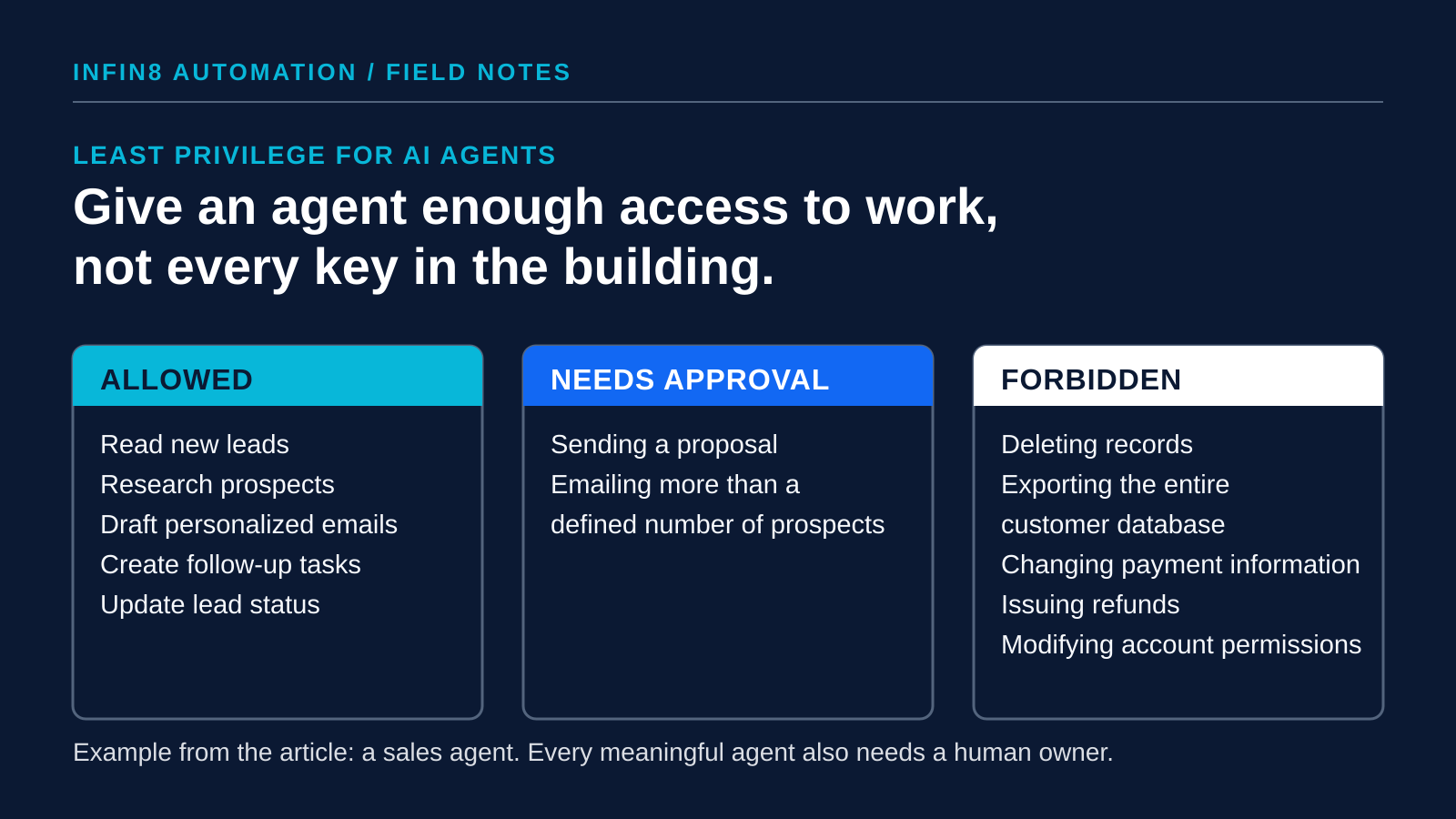
LEAST PRIVILEGE FOR AI AGENTS
Give an agent enough access to work, not every key in the building.
- Read new leads
- Research prospects
- Draft personalized emails
- Create follow-up tasks
- Update lead status
- Sending a proposal
- Emailing more than a defined number of prospects
- Deleting records
- Exporting the entire customer database
- Changing payment information
- Issuing refunds
- Modifying account permissions
Example from the article: a sales agent. Every meaningful agent also needs a human owner.
Agent sprawl will look boring right up until it matters
The likely failure mode is not a science-fiction robot rebellion. It is ordinary operational entropy. A former employee built an agent nobody owns. An automation still has access to a mailbox it no longer needs. A connector was granted broad permissions during testing. Two agents can modify the same record. Nobody knows which credential an old workflow uses. An agent's job changed, but its permissions did not.
Businesses already accumulate forgotten software accounts and integrations. Autonomous software makes forgotten access more consequential because the software can act.
The new rule: least privilege plus obvious accountability
Every agent should have the minimum access required to perform its actual job, and every meaningful agent should have a human owner. Sensitive actions should have explicit approval thresholds. Permissions should be reviewed as the agent's role changes. When the agent is retired, its access should be retired with it.
This is not glamorous Artificial Intelligence work. That is precisely why it may become valuable. The exciting part of the agent economy is building digital workers. The durable business around it may be making sure those workers remain understandable, accountable, and controlled.
That is why we built AgentGuard
Infin8 Automation created AgentGuard as a practical control layer for small and midsize businesses adopting AI agents and increasingly autonomous workflows. We inventory the agents and automations, map what they can touch, define allowed and forbidden actions, identify approval gates, assign human ownership, and establish a review rhythm so the map does not become obsolete the moment another tool is connected.
AgentGuard is operational governance. It is not penetration testing, a cybersecurity certification, or a promise that software can eliminate every risk. The goal is simpler and more useful: know who has the keys.
Before you add another AI agent, map the ones you already have.
Start with an Agent Audit. We will inventory the environment and show you where access, ownership, and approval rules need to become explicit.
See AgentGuardSources
Microsoft Entra Agent ID documentation and Microsoft Entra security guidance, updated 2026. OpenAI Workspace Agents for Business documentation and release notes, 2026.