

WHO KNOWS THAT? Why Your Business Keeps Asking the Same Questions
When every answer depends on the same person, your business has a memory problem. Here is how to turn scattered knowledge into a usable business system.

Ask Mike. Unless Mike is out to lunch.
Somewhere in a small business, a customer asks a perfectly reasonable question. Can we handle that unusual request? What did we charge last time? Why does this account have a different process? Somebody knows the answer. The problem is that everybody else knows only who to ask.
Ask Mike. Mike remembers the conversation, the workaround, the customer’s preference and the reason nobody should use the old instructions. That makes Mike valuable. It also makes his lunch break a surprisingly important event in the operation of the business. When he is away, the question waits, the customer waits and somebody starts searching through emails that may or may not contain the answer.
Mike is an illustration, not a story about a particular client. You probably have your own version of him: the owner, the office manager, the person who has been there since the beginning or the employee who somehow remembers every exception. The name changes. The pattern does not. Your business has useful knowledge, but getting to it depends on interrupting the right person at the right time.
That is the question behind this series: WHO KNOWS THAT? It sounds like a request for a name. Underneath it is a design problem. A business should be able to remember what its people have learned and help the next person use that knowledge. When it cannot, experience becomes a bottleneck instead of an advantage.
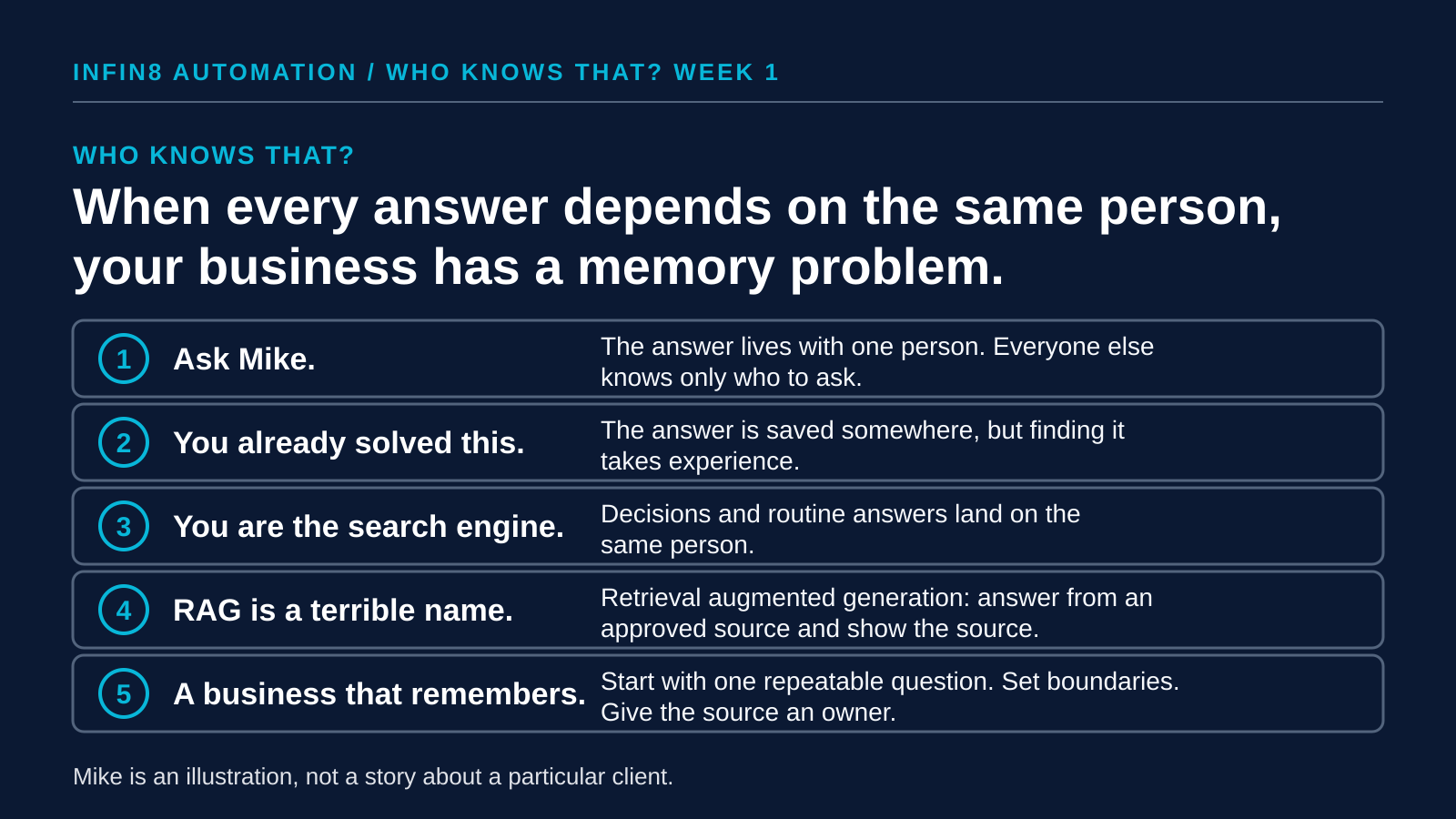
WHO KNOWS THAT?
When every answer depends on the same person, your business has a memory problem.
- 1Ask Mike.The answer lives with one person. Everyone else knows only who to ask.
- 2You already solved this.The answer is saved somewhere, but finding it takes experience.
- 3You are the search engine.Decisions and routine answers land on the same person.
- 4RAG is a terrible name.Retrieval augmented generation: answer from an approved source and show the source.
- 5A business that remembers.Start with one repeatable question. Set boundaries. Give the source an owner.
Mike is an illustration, not a story about a particular client.
You already solved this.
Imagine an employee trying to work out how to handle an awkward customer request. They ask around, read a few old messages and finally develop a sensible answer. A month later, another employee encounters almost the same situation and does the work again. The business has paid for the answer twice, but it still cannot reliably find it.
This is not always a failure to document things. Often the documentation exists. The answer might be in a pricing note, a job folder, an email thread, a spreadsheet comment or a file named after the customer instead of the problem. Each item made sense to the person who saved it. Taken together, they are a collection of hiding places.
A shared drive can make the files available without making the knowledge usable. If somebody has to know the exact filename, the correct folder and the terminology used by the original author, finding an answer still requires experience. The experienced employee becomes the guide to the filing system. The interruption has moved, but it has not disappeared.
The useful question is therefore bigger than whether you have a knowledge base. Can an employee describe the situation in ordinary language and find the approved answer, the source behind it and the conditions that apply? Can they tell whether it is current? Can they see when the answer is outside their authority and needs a person to decide?
Those are practical requirements. A searchable pile of old material is not enough if it gives equal weight to a current procedure and a superseded one. A beautifully formatted manual is not enough if updating it takes so long that everyone quietly returns to asking Mike. Business memory has to connect finding, trusting and maintaining the answer.
Congratulations. You are the search engine.
Owners often take pride in being the person who can answer anything. There is real value in that experience. But answering the same operational questions all day uses time that could go toward customers, decisions, training or the work that actually requires the owner’s judgment. Expertise is doing two jobs: making decisions and retrieving information.
The difference matters. Deciding whether to make an exception for an important customer may require the owner. Finding the approved steps for a routine handoff should not. When both requests arrive through the same person, the routine ones crowd the calendar and the important ones have to compete for attention.
Look at a normal week and separate the interruptions. Which questions ask for a decision? Which ask for something the business already knows? Which recur because the written process is missing a step? Which recur because the answer exists but is hard to find? This small exercise tells you more than starting with a shopping list of software.
Consider a new employee asking how to prepare a job for the next team. If the answer changes every time, the business needs to agree on a process. If there is an agreed process buried in a document, it needs a better retrieval path. If the process is clear but the employee is not allowed to see it, permissions need attention. The same question can point to very different problems.
The goal is not to eliminate conversations. Good teams talk, teach and make decisions together. The goal is to stop using a conversation as the only way to retrieve a settled answer. Your best people should spend their attention on situations that need their expertise, while the business handles the ordinary work of remembering.
RAG is a terrible name. The underlying idea is useful.
The technology industry calls one approach retrieval augmented generation, usually shortened to RAG. The name is unlikely to improve anybody’s lunch break. The underlying idea is easier to understand: find relevant information from an approved source, then use it to help produce an answer to the question.
A knowledge base is the collection of information. Retrieval augmented generation is a method for using selected information from that collection when a person asks a question. The two are related, but they are not interchangeable. A well-maintained knowledge base can be useful on its own. Adding an answer layer does not remove the need to keep the underlying material accurate.
Think about asking, “What do we need before we hand this type of job to production?” A conventional search might return documents containing those words. A retrieval system looks for relevant material, and a language model can turn the retrieved material into a readable response. In a useful business implementation, the employee should also be able to open the supporting source and check the answer.
The National Institute of Standards and Technology describes retrieval augmented generation as combining a language model with information retrieved from a knowledge base. Microsoft’s documentation explains the importance of retrieval, source preparation and access controls. Those descriptions support the basic mechanism. They do not mean that every system using the label will produce correct answers.
An answer can still be wrong because the source is wrong, the relevant passage was missed, the question was misunderstood or the model drew an unsupported conclusion. A source link helps somebody inspect the answer; it does not automatically prove the answer is accurate. That is why the design has to include boundaries, review and a useful way to say that the system cannot answer.
Start with one repeatable question, not every file in the company.
A practical starting point is one question that comes up often, has a reasonably stable answer and costs somebody time. It might concern a routine handoff, a standard preparation step or how to find an approved customer document. Choose a narrow area where success can be checked by the people who do the work.
Write down several real versions of the question. People rarely ask in the same words as the document title. One employee may ask what production needs. Another may ask whether a job is ready to move forward. A third may ask what they are missing. If all three are asking about the same handoff, a useful system should recognize the connection.
Next, identify the actual approved source. Do not assume the newest file is the correct one. Have the person responsible for the process confirm the steps, the exceptions and the circumstances in which somebody must stop and ask for a decision. Where two sources disagree, resolve the disagreement before asking software to produce a confident answer.
Give the source an owner and a review date. Make the superseded version clearly distinguishable from the current one. Keep the language specific enough for somebody new to follow. If a step says to check that everything is ready, say what ready means. The work of clarifying the process is valuable even before any answer tool is connected.
Finally, test the questions against the source. A successful answer should help the employee take the correct next step and show where that instruction came from. Test a question that is slightly different, one that falls outside the process and one that contains a mistaken assumption. The system needs to handle uncertainty as carefully as it handles the straightforward example.
A business that remembers still needs boundaries.
Not every employee should be able to retrieve every piece of information. A customer preference, a public service explanation, an internal operating procedure and a private employee record have different purposes and audiences. Putting them into one answer system without preserving those distinctions creates a problem that better wording cannot fix.
Access should follow the permission to use the source information. If someone cannot open a document, the answer layer should not reveal its contents indirectly. Microsoft’s retrieval guidance addresses security trimming, the practice of limiting retrieved material to information the user is allowed to access. The implementation needs to enforce that rule rather than trusting a prompt to remember it.
Customer information needs similar care. A system intended to help staff find approved procedures should not casually expose another customer’s private details as an example. Before connecting material, decide what belongs in the source collection, what should be removed and whether the planned use fits the permissions and consent already in place.
Pricing also needs a clear boundary. A past estimate may explain what happened on a previous job, but it does not necessarily authorize the same price today. If the current offer, pricing rules or approval process say otherwise, the current rules control. A helpful answer should distinguish historical context from permission to make a new commitment.
These limits are part of the operating system, not an extra paragraph at the bottom of a screen. The employee needs to know when they can proceed, when they should check the source and when the question requires human judgment. A system that admits it has no approved answer can be more useful than one that confidently manufactures a plausible response.
What happens when your business remembers?
When useful knowledge becomes easier to retrieve, the benefit shows up in ordinary work. A new employee can find the current handoff steps without waiting for the one person who remembers them. A customer-facing employee can locate an approved explanation before answering. An experienced employee can spend less time repeating a settled instruction.
Those are possibilities to test, not results to promise before the system exists. Start by measuring the time spent finding answers in the narrow process you chose. Note how often the same question interrupts someone, how frequently staff use an outdated source and how many questions still need a decision. The starting point gives you something concrete to compare.
After the change, check whether employees reach the right source and take the right next step. A fast answer that causes the wrong action is not a win. Neither is a system everybody avoids because it takes longer than sending a message. Watch the real workflow, including the moments where somebody loses confidence and asks a colleague anyway.
Review those moments with the process owner. Sometimes the search needs improvement. Sometimes the source is unclear. Sometimes an exception was never documented. Each case tells you what to fix. The answer tool can expose weak spots in the business’s memory, but people still have to resolve them.
Maintenance should fit the way the business works. When a procedure changes, the source needs an update, the old instruction needs to stop appearing as current and the affected questions need another check. If nobody owns that small loop, the system will gradually become another place where yesterday’s answer looks like today’s.
Give the next person a better starting point.
The first useful version does not need to know everything. It needs to remember one meaningful part of the operation well enough that the next person can use it. That may mean cleaning up a set of procedures, making a shared knowledge base easier to search or adding a retrieval-based answer layer once the sources and boundaries are ready.
At Infin8, the purpose of a business system is to support the expertise already there. You bring the knowledge of your work, your customers and the way your business needs to run. The system should make that knowledge easier to use in the places where work gets stuck, without inventing new offers, changing your pricing or bypassing the decisions that belong to you.
If WHO KNOWS THAT? is a question your team asks every day, bring one recurring example to a conversation with Infin8. Start with the question, the people it interrupts and the answer you wish the next person could find. That is enough to identify a practical first step.
Mike can still be the person who knows the most. He should also be able to finish his lunch while the business remembers the answer.
Questions this article answers
Is a knowledge base the same as retrieval augmented generation?
A knowledge base stores information. Retrieval augmented generation retrieves relevant information and gives it to a language model to help answer a question. The answer layer still depends on current sources, appropriate permissions and checks for accuracy.
Do we need to connect every company document?
No. Start with one recurring question and a narrow collection of approved sources. Confirm the process, remove conflicting or outdated instructions and test realistic questions before expanding.
Can the system make pricing decisions for us?
Only within the authority and rules you deliberately give it. A past quote does not automatically authorize a new price. Current offers, pricing rules and human approvals should remain in control.
What should happen when there is no approved answer?
The system should make the gap clear and route the question to the responsible person. It should not manufacture an instruction or commitment to sound helpful.
Sources and further reading
See where prospects are getting lost before you spend more to get them.
Infin8's $279 Customer Path Review maps the path from first click to follow-up and identifies the highest-value fixes.