

Small Businesses Do Not Need More Content Ideas. They Need a Content Operating System.
Why small-business content breaks down at the workflow level, and how one useful owner insight can become researched, reviewed, platform-ready content.
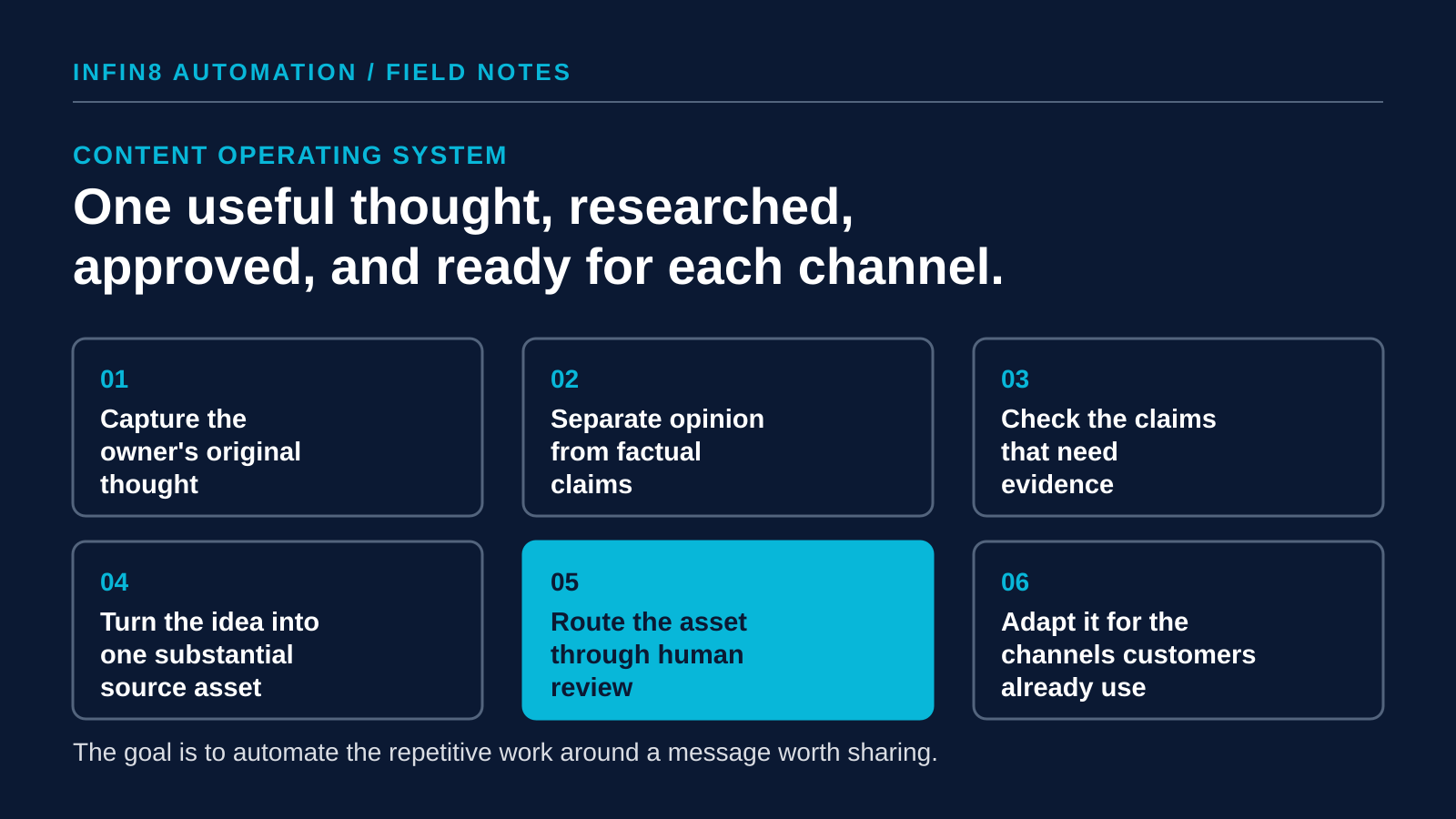
CONTENT OPERATING SYSTEM
One useful thought, researched, approved, and ready for each channel.
- 01Capture the owner's original thought
- 02Separate opinion from factual claims
- 03Check the claims that need evidence
- 04Turn the idea into one substantial source asset
- 05Route the asset through human review
- 06Adapt it for the channels customers already use
The goal is to automate the repetitive work around a message worth sharing.
The real bottleneck is not ideas
Small business owners do not need more content ideas. They need a system that can turn one useful thought into researched, approved, platform-ready content without forcing them to become full-time marketers.
Most owners already produce useful raw material every week. It shows up in customer questions, sales objections, troubleshooting calls, lessons from jobs that went sideways, and the small decisions that only make sense after years in the business. The problem is that those insights usually disappear into calls, texts, notes, and memory instead of becoming durable business assets.
That is why the usual advice to “post more” misses the point. A blank content calendar is rarely the deepest problem. The deeper problem is operational: there is no dependable path from a useful thought to a researched article, a reviewed message, and a platform-ready version that can be published without the owner spending the evening stitching tools together.
What a content operating system actually does
A content operating system starts with the owner’s real expertise and surrounds it with process. It captures the original thought, separates opinion from factual claims, checks the claims that need evidence, turns the idea into one substantial source asset, routes that asset through review, and then adapts it for the channels where customers already pay attention.
That workflow matters because content work tends to break at the handoffs. Content Marketing Institute’s 2025 B2B research found that 45% of respondents said they lacked a scalable model for content creation, while only 35% said they had one. The same research reported lack of resources as a challenge for 54% of respondents and workflow or approval issues for 33%. Those figures describe B2B marketers rather than all small businesses, but they illustrate the operating problem clearly: creating content repeatedly is difficult when the process depends on scattered tools and improvised handoffs.
The goal is not to automate the owner out of the message. The goal is to automate the repetitive work around a message worth sharing.
Research is a control, not decoration
A useful system also has to know the difference between a point of view and a claim. “Customers keep asking us this question” is experience. “Most businesses lose half their leads” is a factual assertion that needs support. Treating those two things as interchangeable is how fast content becomes unreliable content.
Research should therefore sit inside the workflow, not as an optional cleanup step after drafting. Numbers, dates, names, regulations, product details, and market claims should be checked before the draft presents them as true. The system should preserve qualifications when the evidence only applies to a particular population, industry, or time period.
That is one reason a human approval gate still matters. Artificial intelligence can compress the research and drafting cycle dramatically, but the final public package still needs someone accountable for what the business is actually saying.
One source asset, many channel-specific outputs
Once the source article is sound, distribution becomes much easier. The article can feed a Facebook post, an Instagram caption, a Threads post, a LinkedIn post, a Google Business Profile update, an email, a sales follow-up answer, or a future video script. The argument stays consistent, but the packaging changes for the platform.
That distinction matters. Repurposing is not copying the same paragraph everywhere. A Facebook post can frame the article around a customer problem. Instagram can make the idea visual and concise. Threads can carry one sharp observation. LinkedIn can lean into the operating lesson. Google Business Profile can connect the idea to a local business action. The source stays stable while each destination gets content written for the way people actually use that destination.
This is also why the source article should be treated as durable infrastructure rather than disposable marketing copy. It becomes the verified reference point the rest of the system can reuse.
Human approval belongs inside the machine
Automation is most useful when it removes repetitive effort without removing judgment. Approval should therefore be a designed step, not a ceremonial button after everything is already scheduled. The owner or designated reviewer should be able to see the finished article, the visual, the platform-specific copy, the factual support, and the call to action before anything goes public.
That is the model behind the Infin8 workflow we are building: capture the thought, research it, develop the source content, package the channel versions, stop for approval, publish only what was approved, and then verify the receipts. A successful system should be able to prove what it published and where instead of merely reporting that a job ran.
The better question for a small business
Instead of asking, “What should we post today?” ask, “What useful thing did we explain this week that deserves to become an asset?” That question starts with expertise rather than content pressure.
Infin8 Content is designed around the broader work that happens before and after writing: research, drafting, optimization, review, publishing, scheduling, and measurement. The point is not to create an endless stream of material for its own sake. The point is to create a repeatable path that turns useful knowledge into content without making the owner become the marketing department.
The valuable thing was never the empty calendar slot. It was the useful thought the owner already had. Build the machine around that.
Sources and further reading
See where prospects are getting lost before you spend more to get them.
Infin8's $279 Customer Path Review maps the path from first click to follow-up and identifies the highest-value fixes.