
Marketing Agency vs Lead Automation Company: Which One Do You Actually Need?
A marketing agency gets you noticed. A lead automation company makes sure interested people do not disappear after they raise their hand.
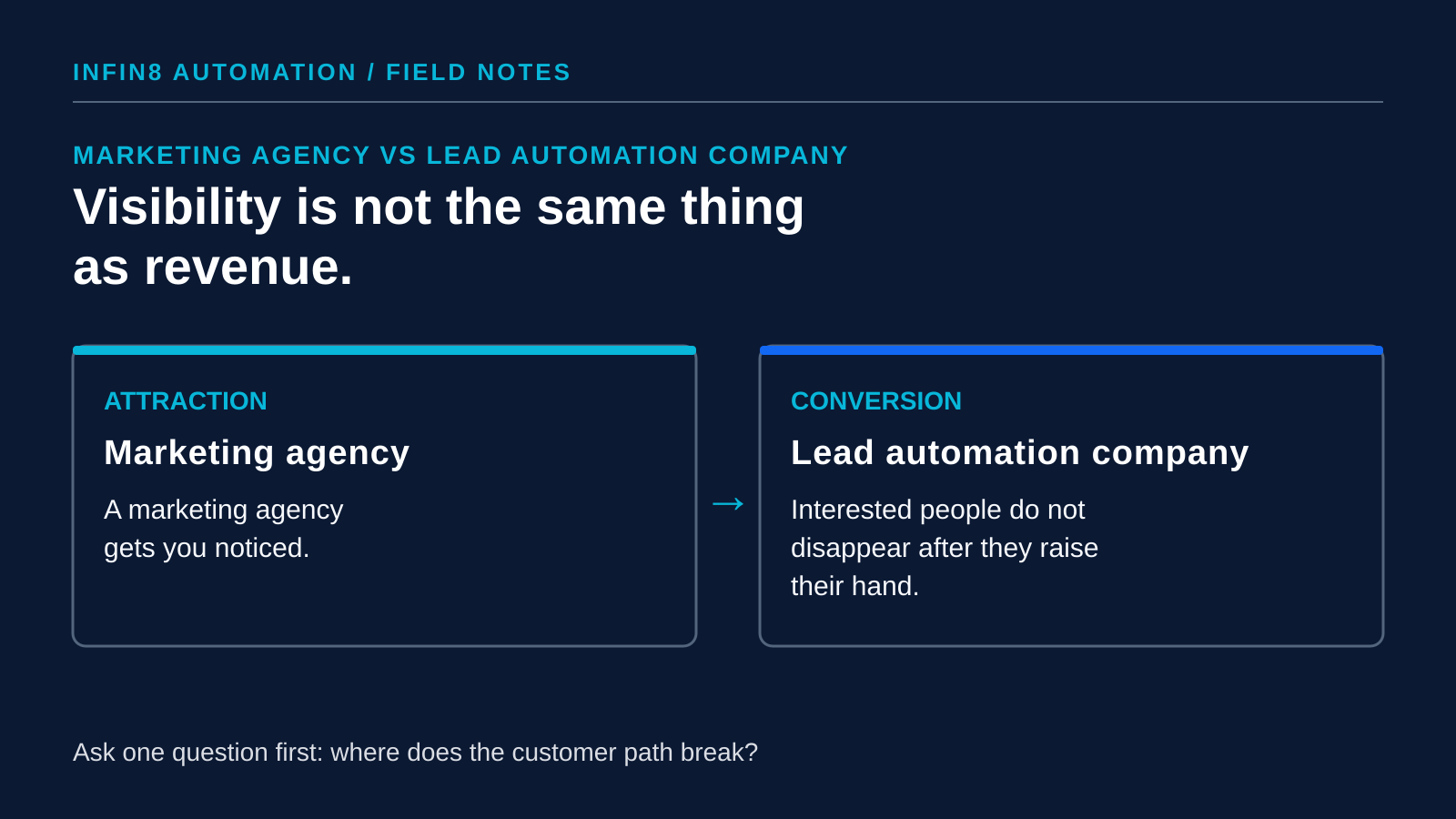
MARKETING AGENCY VS LEAD AUTOMATION COMPANY
Visibility is not the same thing as revenue.
- ATTRACTIONMarketing agencyA marketing agency gets you noticed.
- CONVERSIONLead automation companyInterested people do not disappear after they raise their hand.
Ask one question first: where does the customer path break?
Visibility is not the same thing as revenue
A marketing agency and a lead automation company are not the same animal. They may both sit near the customer acquisition conversation, but they solve different problems.
A marketing agency helps more people notice you. It can help with brand, campaigns, paid ads, content, Search Engine Optimization (SEO), social media, and the general job of getting your name in front of the right market.
A lead automation company starts where that usually stops. It catches the person who already showed interest, routes the inquiry, sends the first response, books the next step, updates the Customer Relationship Management (CRM) system, and makes sure the opportunity does not vanish into somebody's inbox like a sock in the dryer.
That difference matters because a lot of small businesses do not have one clean problem. They have a customer path problem. They buy more attention when the real issue is response speed, follow-up, handoff, or tracking.
The clean split: attraction vs conversion
The agency lives mostly at the top of the funnel. Its job is to make the market aware of you and create demand. It wants more impressions, clicks, calls, form fills, traffic, and inquiries. Done well, that is valuable work.
The automation system lives after the hand raise. Its job is to turn demand into a conversation before the customer cools off or calls someone else. That means fast response, clean routing, text follow-up, email follow-up, calendar booking, reminders, and reporting.
This is why the phrase “we need more marketing” can be dangerous. Sometimes it is true. Sometimes it is just the business-owner version of pouring more water into a bucket that cannot hold it.
Before you spend another dollar getting more people to the front door, make sure the door actually opens.
The five-minute problem
Speed matters because intent has a half-life. Someone who fills out a form or clicks to call is not making a museum donation. They want help, pricing, clarity, a quote, a booking, or at least proof that a real business is alive on the other side.
Harvard Business Review summarized the problem in The Short Life of Online Sales Leads: many companies were not responding nearly fast enough to online inquiries. The core lesson still holds for local service businesses today. The first useful response is often the difference between a live opportunity and a cold record in a spreadsheet.
That is where lead automation earns its keep. It does not need to replace humans. It needs to stop the dead zone between “customer asked” and “business responded.”
The goal is not robotic nonsense. The goal is a fast, useful first touch that says: we got you, here is the next step, and you are not floating in the void.
What a marketing agency usually does
A good marketing agency helps with positioning, messaging, creative, media buying, landing pages, email campaigns, content calendars, search strategy, brand polish, and campaign reporting.
That is front-end growth work. It helps the business become easier to find and more attractive when people compare options.
The danger is when the agency is expected to magically fix everything after the inquiry arrives. Some agencies can build simple automations. Some can connect forms. Some can even help with CRM setup. But if the core business model is campaigns and content, the follow-up machine is usually not where the deepest expertise lives.
That does not make agencies bad. It just means you should not hire a visibility company and expect it to behave like an operations system.
What a lead automation company usually does
A lead automation company designs the machine that catches and moves demand. That includes form routing, missed-call text-back, email sequences, CRM pipelines, calendar booking, lead source tracking, review requests, customer reactivation, and owner notifications.
In plain English: it makes sure inquiries are captured, contacted, followed up with, and visible to the people who need to act.
This is not about having a thousand tools. The stack can be simple. Google Sheets, Google Calendar, Gmail, a form, an automation layer, and a clean CRM can outperform an expensive mess if the process is designed correctly.
The best automation is boring in the way a cash register is boring. It works, it records the thing, and it keeps the business from guessing.
Which one do you need first?
Ask one question first: where does the customer path break?
If nobody knows you exist, your phone is silent, search is weak, your offer is unclear, and traffic is nonexistent, you probably need marketing. You need awareness and demand creation before automation has much to catch.
If inquiries already come in but they sit, scatter, go unanswered, get followed up with days later, or never make it into a clean pipeline, you probably need lead automation first. More traffic will only make the broken handoff more expensive.
A lot of small businesses eventually need both. But order matters. If your follow-up is broken, fix the handoff before buying more pressure.
The Infin8 Automation view
We do not build websites as decorations. We build business machines.
That means the website, the form, the calendar, the CRM, the email notification, the text follow-up, the reporting, and the next-step offer all need to connect. Not someday. Not theoretically. In the actual customer path.
Marketing creates attention. Automation protects the opportunity. The win is connecting both so the business gets more customers with less chaos.
So before you ask whether you need a marketing agency or a lead automation company, diagnose the customer path. If the market cannot find you, build visibility. If the market can find you but your opportunities keep disappearing, build the machine.
Sources and notes
Harvard Business Review: The Short Life of Online Sales Leads — used for the response-speed principle behind the five-minute problem.