Infin8 Agent Rescue Desk: When the Autonomous Agent Needs a Human Tool
What happens when an autonomous AI agent can complete almost the entire workflow but still needs a human for the last strange exception? That gap may become infrastructure.
AGENT RESCUE DESK
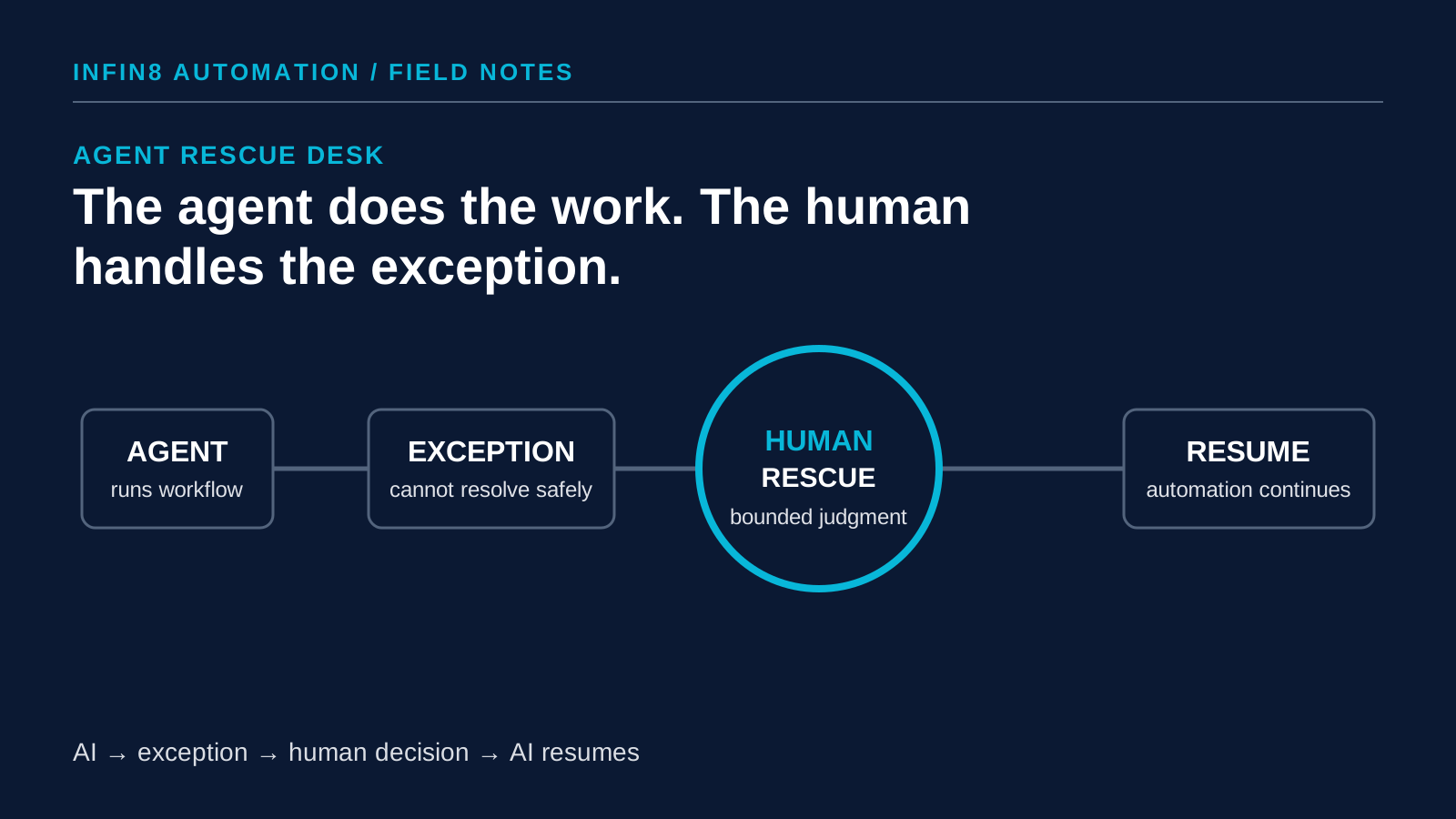
The agent does the work. The human handles the exception.
- AGENTruns workflow
- EXCEPTIONcannot resolve safely
- HUMAN RESCUEbounded judgment
- RESUMEautomation continues
AI → exception → human decision → AI resumes
Infin8 Agent Rescue Desk
Today's signal is unusually useful because it exposes something the AI industry would rather engineer away than sell. Meta is testing a human concierge behind Muse, its autonomous personal agent. Reuters reported that when Muse needs to make some phone calls, human contractors can step in and complete them for the agent. Muse can then return the resulting transcript and information to the user.
That is fascinating. One of the world's largest AI companies has effectively discovered a very practical rule: sometimes the autonomous agent needs a human tool.
I think there is a small-business infrastructure business hiding inside that sentence.
Infin8 Agent Rescue Desk is a human exception layer for autonomous AI systems. The agent performs the work normally. When it encounters something it cannot reliably complete, it does not simply fail, hallucinate, or dump the task back onto the customer. It calls a human as another tool. The human resolves the exception. The agent resumes.
The human isn't doing the job. The human is doing the 3% the machine couldn't do. That distinction is the business.
Why it exists now
AI agents are becoming capable enough that the economics of human labor change. The valuable question is no longer necessarily, “Can AI replace this entire job?” It is, “Can AI perform 95% of this workflow while humans sell tiny slices of judgment for the remaining 5%?”
There is evidence that the failure layer remains substantial. Talkdesk's 2026 research found broad AI deployment across customer journeys while cross-department orchestration remained much less common. The same research described fragmented systems, context loss between systems, and meaningful amounts of employee time spent switching tools, re-entering information, and reconstructing context.
Separate browser-agent testing has also found transaction-heavy work, forms, and third-party integrations among the weaker areas for current agents. That is exactly where reality gets sticky: the payment screen changed, the vendor wants a phone call, a form asks a question no workflow anticipated, or a customer references an old promise that exists nowhere in the current system.
Meta's Muse experiment is the strongest signal because it makes the pattern concrete. Even a frontier consumer agent can benefit from human execution behind the scenes. The interesting opportunity is not pretending that humans disappear. It is designing the handoff so the human enters for thirty seconds instead of inheriting the whole workflow.
The asymmetric version
Do not start a call center. That destroys the economics.
Instead, build an exception marketplace or Application Programming Interface. Agents submit structured rescue jobs: need a human phone call, need a website challenge completed, need an ambiguous document interpreted, need a vendor contacted, need physical-world information verified, need a judgment call, need identity verification, or need an unusual booking completed.
A human completes the tiny task. The result returns to the agent in structured form. Eventually, rescue.request() becomes another tool available to an agent, just like email.send(), calendar.book(), or crm.update(). Except the tool happens to contain a human.
That is the delicious inversion. Instead of humans using AI tools, AI uses humans as tools.
Consider a lead-recovery agent. It receives a lead, qualifies the prospect, follows up, answers ordinary questions, checks the calendar, and schedules the appointment. Then the customer says, “I talked to Mike last year and he said he'd honor the old $1,200 price, but I don't remember exactly what package that included.”
The agent should not invent an answer. It should open a rescue package containing the customer, objective, blocker, recommendation, conversation summary, and one required human decision. The owner sees: Customer: Jane Smith. Objective: Book installation. Blocker: Historical verbal pricing agreement. Agent recommendation: Verify with owner. Conversation summary: 146 words. Required human decision: Honor $1,200 pricing?
The human resolves only that exception. The agent continues the workflow.
Who pays
I would not sell this directly to ordinary small businesses first.
The first customers are more likely to be AI automation agencies, Managed Service Providers, vertical Software-as-a-Service companies, voice-agent companies, and agent developers. They already have autonomous workflows in the field. Their pain is not convincing a business owner that agents exist. Their pain is what happens when those agents hit the edge cases.
The value proposition is simple: do not staff every possible exception inside your own company. Give the agent one standardized human escalation layer and pay only when it needs help.
That also makes the product more defensible than a generic virtual-assistant service. The unit of work is not an hour of labor. The unit is a structured exception with machine-readable context, a bounded human action, and a result that lets the automation resume.
Why competitors may miss it
Business Process Outsourcing companies sell human labor. AI companies sell automation. Automation agencies sell agents. Customer-service companies sell human escalation inside their own platforms.
The unusual category is human judgment as an agent-callable infrastructure service.
The agent is the customer. The human is effectively an Application Programming Interface. That is early.
The real moat may not be the human network anyway. It may be the corpus created by the rescue events. Every exception teaches the system something: where agents fail, what context humans need, which actions resolve the problem, how long rescue takes, and whether the agent can resume afterward.
Over time, repeated exception types can move from human rescue into deterministic automation. The rescue layer therefore becomes both an operational safety net and a discovery engine for the next automation opportunity.
Revenue model
A simple agency-first model could look like this: Agency Starter at $299 per month for 50 rescue events, Agency at $799 per month for 250 events, and Agency Pro at $1,499 per month for 750 events. Overage pricing could land somewhere around $2 to $10 per rescue depending on task complexity.
Twenty agencies averaging roughly $800 per month would represent about $16,000 in Monthly Recurring Revenue. That is an illustration, not a forecast.
The validation economics are unusually friendly. A manual proof could cost between $0 and $200 and take roughly two to three hours to stand up. The capital requirement is low because the first version does not need a marketplace, a call center, or sophisticated scheduling. It needs a clean rescue request, a human response, and a reliable return path to the agent.
The biggest risk is obvious: frontier agents may improve fast enough that the exception rate collapses before a meaningful market forms. But even that does not automatically kill the model. If an agent goes from needing humans 10% of the time to 2% of the time, Rescue becomes cheaper infrastructure, not necessarily unnecessary infrastructure. Airplanes became extraordinarily reliable. We did not therefore remove emergency systems.
One concrete action today
Do not build this yet. We are already knee-deep in the Infin8 agent architecture.
Instead, add exactly one field to the next complete Thought to Social acceptance test: HUMAN RESCUE REQUIRED?
Every time Thought to Social cannot autonomously proceed, record why it stopped, what information the human needed, what the human did, and whether Thought to Social could resume afterward. After 10 complete Thought to Social runs, count the rescue events. If there are none, park this. If there are repeated rescue patterns, we have produced our first real dataset without spending a dollar.
AgentGuard prevents bad behavior. Black Box records behavior. Acceptance Testing tests behavior. Rescue Desk handles the moment when otherwise-good automation encounters reality and says, essentially, “I need an adult for thirty seconds.”
That is not a failure of automation. It may be the missing interface between autonomous software and the stubbornly human world it still has to operate inside.
Questions this article answers
What is a human exception layer for AI agents?
It is a structured way for an autonomous agent to request a small human action or judgment when the workflow reaches an exception the agent cannot safely resolve, then return that result so automation can continue.
Is Agent Rescue Desk a call center?
No. The concept is deliberately narrower: humans resolve bounded exceptions rather than taking over whole workflows.
Who would buy an Agent Rescue Desk first?
The earliest likely buyers are automation agencies, Managed Service Providers, vertical software companies, voice-agent vendors, and developers already operating autonomous workflows.
Sources and further reading
See where prospects are getting lost before you spend more to get them.
Infin8's $279 Customer Path Review maps the path from first click to follow-up and identifies the highest-value fixes.