

Can You Just Talk to Your Phone for Five Minutes Every Week and Have It Run Your Social Media? Ladies and Gentlemen, the Answer Is Yes.
Infin8 tests a voice-first content system by recording the rant that becomes the article. Business owners do not need to become content creators. They need a capture system.
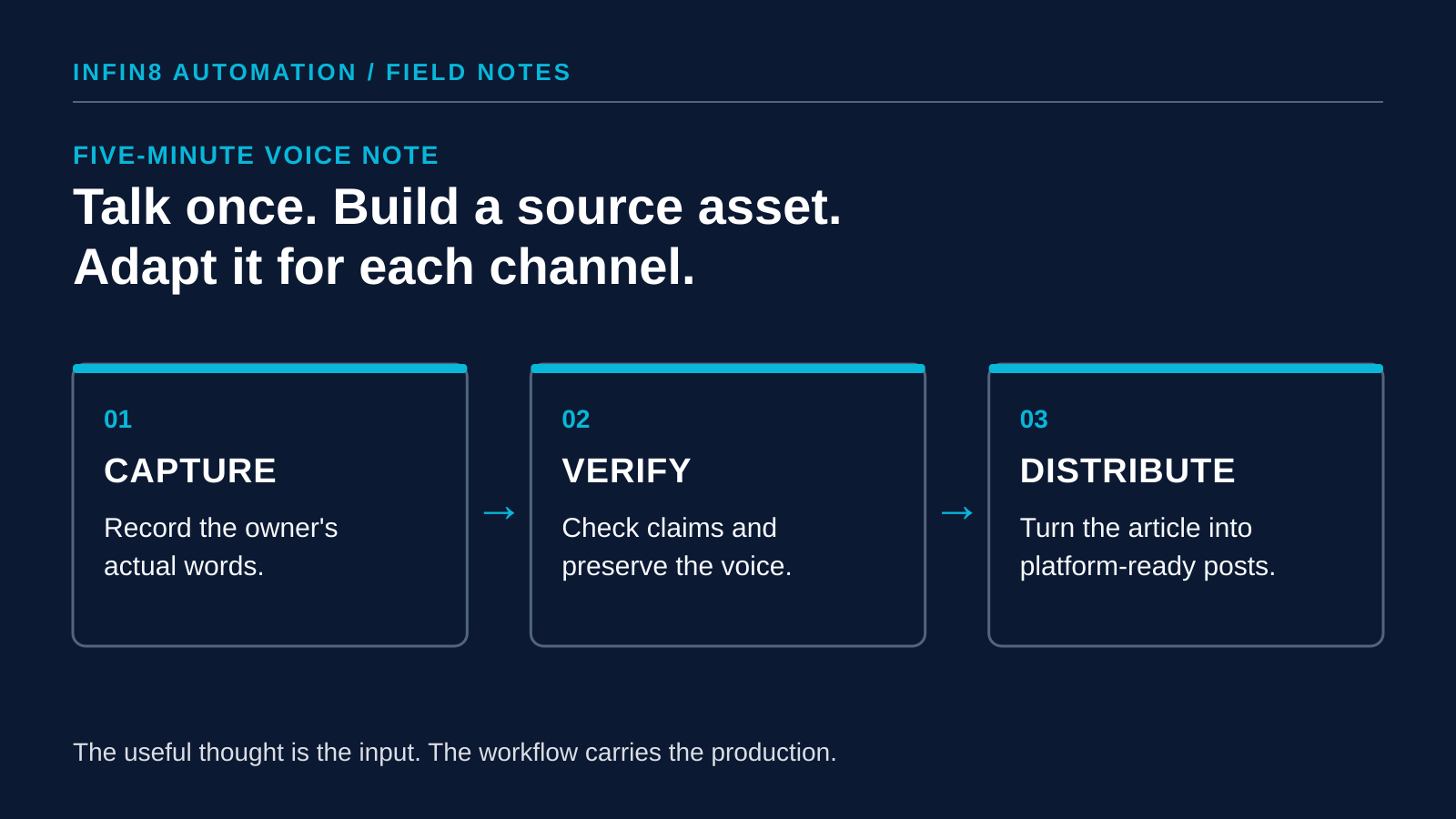
FIVE-MINUTE VOICE NOTE
Talk once. Build a source asset. Adapt it for each channel.
- 01CAPTURERecord the owner's actual words.
- 02VERIFYCheck claims and preserve the voice.
- 03DISTRIBUTETurn the article into platform-ready posts.
The useful thought is the input. The workflow carries the production.
The article started as a rant
I am testing something while writing this, which is exactly the kind of self-referential nonsense I enjoy way too much. This article started as a rant. Not a polished draft, not a content calendar, and not a whiteboard full of pillar content and audience personas that make normal business owners want to fake a Wi-Fi outage.
I talked. That was the whole first step. I talked into my phone about a business idea, a system I am testing, and the question every busy owner quietly asks while staring at an empty LinkedIn box like it owes them money: can you just talk to your phone for five minutes every week and have it run your social media? Ladies and gentlemen, the answer is yes.
Should you blindly dump a voice memo onto the internet and call that marketing? No. That is how you publish a long detour about losing your train of thought in aisle seven of your own brain. But can your real voice become raw material for articles, posts, video scripts, YouTube ideas, follow-ups, and trackable experiments? Absolutely. That is what this article is proving while you read it.
Business owners do not need another blank page
Most business owners do not have a content problem. They have a capture problem. They have opinions, stories, warnings, lessons learned the expensive way, answers they give customers every week, and things they say on sales calls that would make better posts than most polished junk floating around online.
The trouble starts when they sit down to make content. Their voice disappears. Their personality gets put in a tiny corporate filing cabinet. The person who just made a sharp useful point out loud suddenly types a generic corporate opening instead. No. Put the keyboard down. Nobody talks like that unless they are being held hostage by a webinar funnel.
The better move is simple: start with the way you already talk, then use a system to do the boring conversion work. The machine should catch the useful parts, organize them, research what needs proof, and turn the whole thing into something another human can read.
That is not an excuse to publish every thought exactly as it arrived. It is an argument for preserving the useful raw material before the editing brain has time to sand it into something forgettable. Good editing creates a path for the reader. It does not erase the fingerprint of the person who actually knows the work.
The experiment needs rules
A voice-to-content system is useful only if it knows what it is not allowed to do. It should not invent an origin story, invent a customer result, invent a statistic because a paragraph felt lonely, turn a strong opinion into weak mush, or pretend an experiment already has performance data when it does not.
This is case in point, A number one sample. The honest result is not that the article went viral. The honest result is that a live voice rant became a structured content asset with reusable ideas for social and YouTube. The next result comes from publishing, tracking, and improving the system.
Bad AI content says, here is a generic article about social media automation. Good automation says, here is the business owner's actual point, cleaned up enough to be useful, but not sanitized into a beige brochure.
The five-minute workflow
Once a week, record a short rant about one useful thing you actually care about: a customer question, a mistake you keep seeing, a process you fixed, or a belief your industry keeps getting wrong. Talk like you are explaining it to someone riding in the truck with you.
Then run the file through the system. Pull the best exact lines. Summarize messy sections. Flag claims that need research. Separate facts from opinion. Draft the article. Turn the article into channel-specific social posts. Pull short video hooks. Track what gets attention. Feed the results back into the next rant.
That is the machine. Not magic. Not vibes. Not AI will handle my brand. A repeatable capture system that protects the original observation and removes the friction between an owner having a thought and a customer being able to learn from it.
The operating rule is simple. If the system cannot support a factual claim, it either researches it or leaves it out. If a story belongs to a later article, it gets parked instead of getting invented. If the original voice contains the sharpest line, preserve it. This is how a useful business asset stays both interesting and honest.
Why YouTube is probably V2
The obvious next move is video. If the article starts as voice, it is already closer to video than a traditional blog post is. The same rant can become a long-form YouTube idea, a few short clips, a newsletter section, and channel-specific social posts.
That is where the flywheel starts catching other flywheels. The voice rant becomes the article. The article becomes the YouTube outline. The YouTube video becomes clips. The clips become social posts. The comments become the next rant. Now the business is not sitting around wondering what to post. It is building a content machine from things it is already saying.
You guys are on a ride along with me. I am testing my V1 of my personal social media machine that has yet to have a real name. The important part is not pretending V1 is finished. The important part is proving that a system can catch the insight before it disappears.
Video does not have to start as a polished production either. It can start as a recorded explanation with a real hook, three useful beats, and a clear takeaway. The article supplies the research and structure. The original voice supplies the energy. The same source can serve different formats without asking the owner to invent a new personality for each one.
What we are tracking next
The system is being tested in public, which is useful and slightly ridiculous. The first metric is not views. The first metric is whether the system reliably turns a rough owner thought into usable content without making it fake, boring, or wrong.
After that, track which hooks get clicked, which posts get comments, which topics lead to conversations, which video formats deserve repetition, which ideas deserve deeper articles, and which rants should have stayed in the drafts folder. Some rants belong there.
The point is not to automate personality out of the business. The point is to stop losing the good stuff because the owner did not have time to sit down and make content. You do not need to become a content creator. You need a system that captures how you already think. The best system is the one you will actually use.
A system earns trust by showing the work. This article is the first artifact. The next artifacts are the version on the website, the native social adaptations, the future video outline, and the measured response. Each loop should make the next recording easier, the next article sharper, and the customer path clearer.
That is the real test: not whether software can make more words, but whether it helps a business keep its best thinking, publish it responsibly, and turn attention into a useful next conversation that helps a real buyer decide what to do next with confidence today.
Questions this article answers
Can a voice note become a business article?
Yes. A useful workflow captures the original language, verifies factual claims, structures the useful idea, and keeps human judgment in the final publish.
How often should a small business create content?
Start with one strong source article each week or every two weeks. Turn that source into channel-specific social posts and video ideas instead of manufacturing unrelated content.
Does artificial intelligence replace the business owner in this process?
No. The owner supplies the experience, opinions, decisions, and examples. Artificial intelligence reduces the production friction around that real expertise.
What should an owner talk about first?
Start with a customer question, recurring mistake, useful lesson, process improvement, or belief your industry keeps getting wrong.
Sources and further reading
See where prospects are getting lost before you spend more to get them.
Infin8's $279 Customer Path Review maps the path from first click to follow-up and identifies the highest-value fixes.