

Build Proof, Not Content: A Small-Business Content Strategy
A practical small-business content strategy that turns owner expertise, real work, and customer questions into search visibility, trust, and qualified leads.
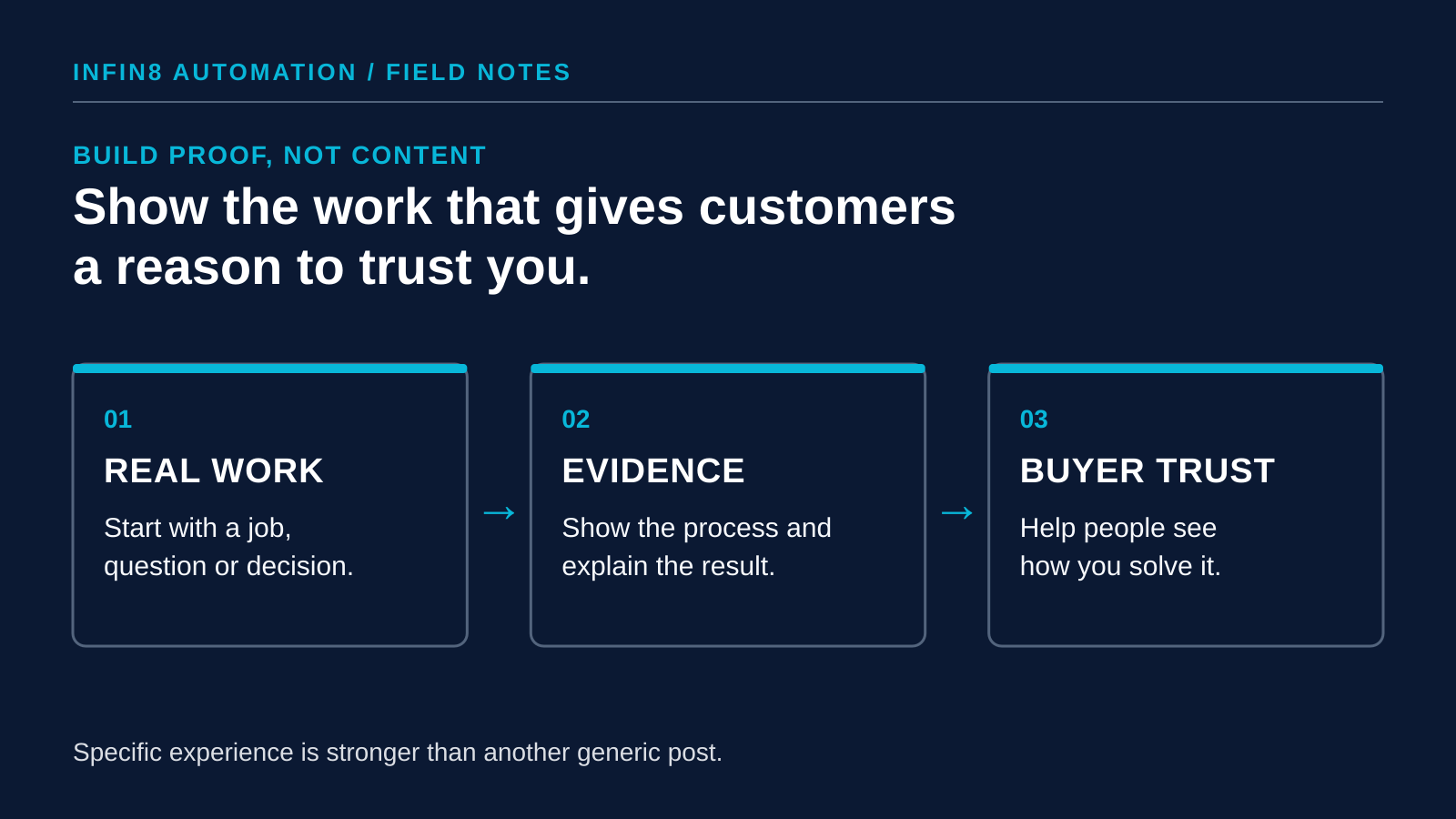
BUILD PROOF, NOT CONTENT
Show the work that gives customers a reason to trust you.
- 01REAL WORKStart with a job, question or decision.
- 02EVIDENCEShow the process and explain the result.
- 03BUYER TRUSTHelp people see how you solve it.
Specific experience is stronger than another generic post.
Most small businesses do not have a content problem
They have an extraction problem.
The useful material is already there. It is hiding in sales calls, estimates, customer questions, project decisions, complaints, explanations, lessons, mistakes, and the stories an owner tells when somebody finally asks the right question. The business produces raw expertise every day, then lets almost all of it disappear.
The operating requirement is simple: make it easy for an owner to contribute real expertise without turning marketing into another full-time job. It is the design brief for a better marketing system. The owner should contribute the judgment, experience, energy, and point of view. The system should handle capture, research, structure, editing, publishing, distribution, and measurement.
That is the difference between creating more content and building a Proof Engine. Content fills a feed. Proof helps a buyer believe you understand the problem and can do something useful about it.
The content treadmill is backward
The usual process starts with a blank calendar. Somebody decides the company needs three posts this week, two videos, a newsletter, and a blog article. Then everyone scrambles to invent topics because the calendar is hungry again.
That is how businesses end up publishing polished nothing: generic advice, recycled lists, empty inspiration, and artificial intelligence copy that could belong to any company in any city. The words may be competent. The signal is weak.
A Proof Engine starts at the opposite end. It begins with what actually happened. What did a prospect misunderstand? Why did a project almost fail? What did the owner notice that the industry keeps getting wrong? What process was improved? What question keeps appearing before a sale? What result can be documented honestly?
Instead of asking, "What should we post?" ask, "What did we learn, build, fix, explain, or prove this week?" That one change moves content from performance to evidence.
What proof actually means
Proof is larger than a testimonial and more honest than a victory lap. A business can show expertise before it has a dramatic case study, but it must label the evidence correctly.
Expertise proof explains a recurring problem with unusual clarity. Process proof shows how the business thinks, decides, checks quality, or prevents failure. Activity proof documents a real build, experiment, review, or improvement without pretending the outcome is known yet. Outcome proof records a verified result with the customer's permission. Trust proof includes authentic reviews, credentials, references, and consistent follow-through.
These layers matter because fake certainty destroys the very trust the content is supposed to create. Do not manufacture a client win. Do not dress a test fixture up as customer data. Do not imply a result that has not been measured. A strong company can say, "Here is what we built, here is why, here is what we checked, and here is what we still need to learn." That is credible proof.
For Infin8 Automation, the operating principle is simple: no placeholders presented as reality, no fake integrations, no invented performance, and no technology theater. Show the work.
The eight-stage Proof Engine
A useful content marketing automation system does not begin with an artificial intelligence writer. It begins with a repeatable path from business activity to a customer-facing asset.
1. Capture: record the owner's rant, a sales conversation, a project decision, a frequently asked question, or a lesson from the work. 2. Extract: identify the strongest claims, stories, phrases, questions, and examples. 3. Verify: research the central topic, check facts, confirm what can be said publicly, and separate evidence from opinion. 4. Build: turn the best idea into one durable source asset, usually an article, guide, video, or case study.
5. Publish: place the source asset on an owned property with a clear title, useful structure, metadata, internal links, and a relevant next step. 6. Distribute: adapt the idea for LinkedIn, Facebook, Google Business Profile, email, and video instead of pasting the same caption everywhere. 7. Route: connect interested readers to a form, review, call, or service path and make sure follow-up happens. 8. Learn: track qualified conversations and customer movement, then update the source asset as the business gains better evidence.
The source article is the trunk. Social posts, short videos, emails, quote cards, and sales snippets are branches. When each channel is treated as a separate tree, the owner gets buried in production.
Capture the real voice before cleaning it up
Artificial intelligence has a nasty habit when used lazily: it turns interesting people into the same cheerful corporate intern. The grammar improves while the person disappears.
The raw source should be preserved before editing. Keep the phrases the owner actually uses, the analogies that arrive sideways, the frustration, the humor, and the sentences no committee would have invented. Then edit for clarity, accuracy, and commercial usefulness without sanding off the fingerprint.
The same pattern appears repeatedly: businesses already have more useful ideas and expertise than they have time to package. That reveals the real constraint. The shortage is not ideas. The shortage is a reliable conversion system that turns spoken insight into permanent assets.
The goal is not to make every article read like a transcript. A good editor creates structure. Research adds depth. Search strategy gives the article a discoverable frame. But the energy and the original observation must still belong to the person whose name is on the page.
Where artificial intelligence earns its keep
Artificial intelligence is valuable here because the expensive friction lives between the owner's insight and the finished system. A recorded conversation can be transcribed. Claims can be extracted. Questions can be clustered. Research can be gathered. A draft can be structured. Channel-specific versions can be prepared. Metadata, internal links, and follow-up tasks can be checked.
That does not mean the machine becomes the expert. It means the machine does more of the transformation work around the expert.
This distinction matters as adoption grows. The U.S. Chamber of Commerce reported in its 2025 small-business technology research that 61 percent of Florida small businesses were using an artificial intelligence platform, while 78 percent believed AI would help their business in the future. Access is becoming common. A working operating method is still rare.
The advantage is not access to a chatbot. The advantage is a system that preserves source material, checks facts, protects private information, requires approval where judgment matters, and connects the finished asset to a business outcome.
SEO, answer engines, and generative search want the same core asset
Search Engine Optimization, Answer Engine Optimization, and Generative Engine Optimization are often sold as three separate mysteries. The labels differ, but the durable work overlaps: publish clear, original, useful material; make the business and topic easy to understand; answer real questions; support claims; connect related pages; and give the reader a sensible next action.
Google's current guidance for generative artificial intelligence features says website owners should prioritize foundational SEO and unique, expert-led, non-commodity content. It explicitly warns against chasing supposed GEO hacks, stuffing pages with every possible long-tail phrase, or creating special AI files in the hope of gaming discovery.
A strong Proof Engine fits that guidance naturally. Firsthand observations create information competitors cannot simply synthesize from the same public sources. Direct answers make passages useful to people and machines. Named entities, service descriptions, locations, author information, sources, and internal links give the material context. Article and FAQ structured data provide additional machine-readable clues without pretending schema alone creates authority.
For Infin8 Automation, that means writing for business owners searching ideas such as small-business content strategy, content marketing automation, AI automation for small business, customer acquisition systems, lead follow-up automation, and search and AI visibility. Fort Lauderdale and South Florida belong where location is genuinely relevant, not sprayed across every paragraph like digital confetti.
Content without a customer path is expensive theater
A useful article can earn attention and still fail commercially. If the reader reaches the bottom and finds no relevant next step, the business has created a dead end.
The article should connect to the next honest decision. A person learning how to document expertise may need a content system. A business that cannot be understood in Google or artificial intelligence answers may need search and AI visibility work. An owner who suspects the entire path is leaking may need a Customer Path Review before paying for a larger build.
After the click, the mechanics matter. The form must work. The source must be recorded. The right person must be notified. The lead needs a timely, useful response. The business needs to know whether the article contributed to a qualified conversation, proposal, booking, or sale.
Views are not worthless, but they are not the finish line. The commercial chain is: useful proof earns attention; attention builds trust; trust creates action; follow-up turns action into a conversation; and the conversation creates the opportunity for revenue.
The small-business advantage is proximity
Large companies can buy production. Small businesses can publish something large companies struggle to manufacture: close-range knowledge of the customer.
The contractor hears why homeowners delay. The party-rental operator knows which venue constraints blow up a plan. The attorney hears the wording clients use before they understand the legal category. The auto shop knows which symptom customers describe incorrectly. The local service owner sees the moment trust breaks and the question that restores it.
That language should shape the content library. It improves sales because it sounds familiar to the buyer. It improves search coverage because it includes the real problems and questions people express. It improves artificial intelligence discovery because the page contains specific relationships between a problem, a process, a place, and a provider.
A national competitor may publish more. A focused local company can publish closer to the truth.
What to capture first
Do not begin with a hundred-topic calendar. Begin with five evidence streams already moving through the business.
Capture the questions prospects ask before they will book. Capture the objections that repeatedly slow down a sale. Capture the process details that separate responsible work from a shortcut. Capture the decisions and experiments happening inside the company. Capture real results only when the measurement and permission are in place.
A simple weekly prompt can uncover the source material: What happened this week that a customer would find useful, surprising, reassuring, or expensive to ignore? Record the answer while it is fresh. Do not force it into polished language at the point of capture.
One conversation can easily produce a dozen connected ideas, future articles, videos, deep dives, and series. The operating system should not suppress that abundance. It should catch it, separate the threads, and decide which idea deserves to become the source asset now.
A realistic 30-day starting rhythm
Week one: record one substantial conversation around a real buyer problem. Extract the central claim, the strongest personal language, the customer questions, and any facts that require verification. Choose one article—not seven.
Week two: research and build the source article. Add a specific title, a human-first description, a clear author, useful headings, sources, internal links, and one relevant call to action. Publish it on the company's own website so the permanent asset lives somewhere the business controls.
Week three: create native derivatives. LinkedIn receives the business argument and a discussion prompt. Facebook receives the relatable owner story and practical takeaway. Google Business Profile receives a concise local update with one clear action. A short video receives a spoken hook, three beats, and a closing line—not a robotic reading of the article.
Week four: review what produced meaningful signals. Look beyond impressions. Did the right people click? Did anybody reply with a real problem? Did the article support a sales conversation? Did a search query reveal a follow-up question? Feed those answers into the next source piece.
Then repeat. One credible source asset per week is already a serious publishing operation when the derivatives and customer path are connected.
Build the library while building the company
The Proof Engine became more real because the business itself was producing the material. Systems were being designed. Websites were being rebuilt. Integrations were being tested. Decisions, failures, corrections, and breakthroughs were accumulating faster than anyone could package them.
That is the opportunity for any serious operator. Do not wait until the story is over. Document the parts you can verify while the business is being built. Explain what changed and why. Publish the lesson. Connect it to the problem a customer is trying to solve. Return later with better evidence.
The software becomes proof. The proof becomes content. The content becomes authority. The authority creates qualified conversations. Those conversations create customers and better information. Better information improves the system.
Build proof, not content. The feed expires. The library compounds.
Questions this article answers
What is a Proof Engine for a small business?
A Proof Engine is a repeatable system that captures real business knowledge and activity, verifies the material, turns it into durable customer-facing assets, distributes those assets by channel, connects interested people to a next step, and learns from the resulting customer conversations.
How is a Proof Engine different from a content calendar?
A content calendar begins with publishing slots that need to be filled. A Proof Engine begins with real customer questions, work, decisions, processes, and verified outcomes. The calendar schedules distribution; it does not invent the substance.
Can artificial intelligence create content in an owner's real voice?
Yes, when the workflow starts with authentic source material and keeps human approval in the loop. Artificial intelligence can help transcribe, organize, research, draft, edit, and repurpose, but the expertise, claims, examples, and final judgment should remain grounded in the owner and the business.
Does content marketing automation help with SEO and AI search visibility?
It can when automation supports original, helpful publishing rather than mass-producing generic pages. Clear answers, firsthand expertise, credible sources, descriptive metadata, internal links, and technically accessible pages help search engines and answer systems understand the business and its topics.
How does business content turn into customers?
Content helps the right buyer discover the company, understand the problem, and build enough trust to act. The commercial result depends on connecting that action to reliable lead capture, routing, follow-up, and measurement. Content is the authority layer inside a larger customer acquisition system.
What should a service business document first?
Start with repeated buyer questions, sales objections, process explanations, common mistakes, project decisions, and verified results. Choose the material closest to a current customer problem and build one authoritative source asset before creating social derivatives.
Sources and further reading
- Google Search Central: Creating helpful, reliable, people-first content
- Google Search Central: Optimizing for generative AI features on Google Search
- Google Search Central: Introduction to structured data markup
- U.S. Chamber of Commerce: 2025 Empowering Small Business report
- U.S. Small Business Administration Office of Advocacy: AI in Business, Small Firms Closing In
See where prospects are getting lost before you spend more to get them.
Infin8's $279 Customer Path Review maps the path from first click to follow-up and identifies the highest-value fixes.