
76% of Small Businesses Say They Use AI. Only 14% Have Actually Integrated It.
The AI gap isn't adoption anymore. It's integration. The businesses that turn powerful tools into operating systems will have a completely different advantage from the businesses that merely use them.
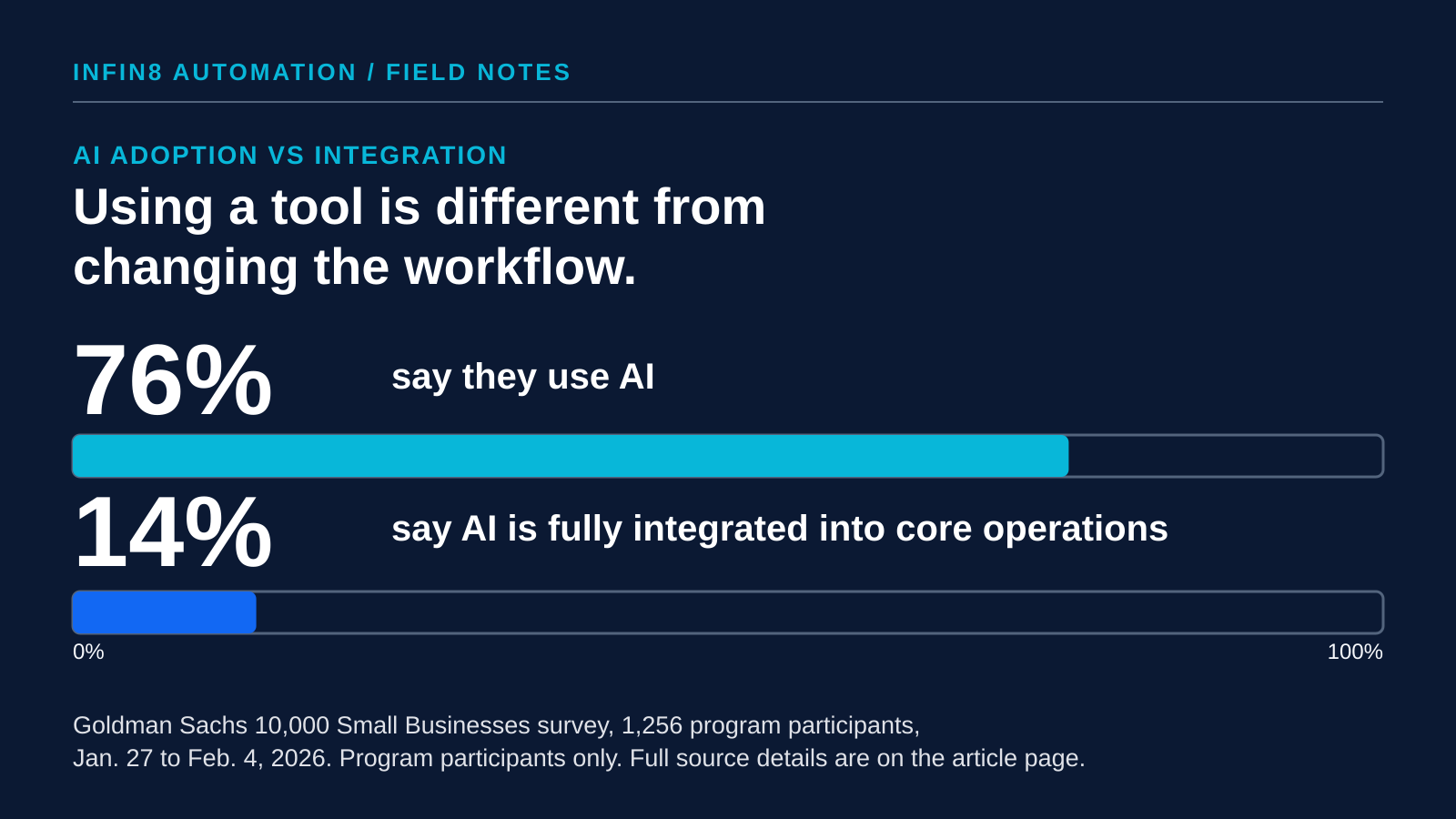
AI ADOPTION VS INTEGRATION
Using a tool is different from changing the workflow.
Source: Goldman Sachs 10,000 Small Businesses survey of 1,256 program participants across the 50 states, DC, and Puerto Rico. Fieldwork January 27 to February 4, 2026, by Babson College and David Binder Research. Published March 17, 2026. Results describe these program participants.
The AI race has moved past access
A year or two ago, simply using artificial intelligence could make a small business feel early. That advantage is evaporating fast.
Goldman Sachs surveyed 1,256 participants in its 10,000 Small Businesses program in early 2026. Seventy-six percent said they were already using AI. Among those users, 93% said it was having a positive impact and 84% cited greater efficiency and productivity. Those are enormous adoption numbers for technology that only recently became broadly accessible.
Then comes the number that matters more: only 14% said AI was fully integrated into core operations.
That gap is the story. Small businesses are not waiting to try AI. They are trying it everywhere. The problem is that trying a tool and redesigning a business around what the tool can do are completely different things.
Using AI is not the same thing as integrating AI
If an owner opens ChatGPT three times a week to write an email, the company uses AI. If somebody asks an AI assistant to summarize a document, the company uses AI. If the marketing person generates captions faster, the company uses AI.
Those can all be useful. None of them necessarily change how the business operates.
Integration begins when the technology is connected to a repeatable business process. A lead arrives and the system knows what happens next. A missed call creates a follow-up. A proposal that goes quiet enters a sequence. A completed job creates a review request. A useful conversation becomes an article, social content, and a permanent knowledge asset. A manager can see where opportunities are leaking without assembling five spreadsheets by hand.
That is a different category of value. The artificial intelligence stops being a clever destination people visit and starts becoming part of the machinery around the work.
The Federal Reserve found the same implementation gap
The Goldman Sachs survey is not standing alone. The Federal Reserve Banks' 2026 Report on Employer Firms found that 46% of employer firms were using AI and another 15% planned to begin within twelve months.
Among the firms already using it, roughly half described themselves as experimenting. Forty-four percent said AI was partially integrated into business processes. Only 7% of AI users said it was fully integrated into the business.
The most common uses were writing or marketing, individual productivity, and planning or analysis. Those are logical starting points because they are easy to access and require very little operational redesign.
But the same report identified the next wall: adapting tools to meet business needs was one of the most common challenges. That is exactly where the market is moving. The question is no longer whether an owner can get access to a powerful model. The question is whether the business can turn that capability into a reliable system.
The chatbot phase was the tutorial
The first phase of mainstream AI adoption taught millions of people how to prompt. That mattered. It gave ordinary businesses access to writing, analysis, research, coding, brainstorming, image creation, and increasingly capable agents.
But prompts are not an operating model.
A business does not become automated because the owner has a folder full of excellent conversations with an AI. It becomes more automated when the useful parts of those conversations can be turned into repeatable actions with clear permissions, data, handoffs, checks, and outcomes.
The next phase is less glamorous and far more valuable. It is integration work: connecting customer acquisition, follow-up, content, reporting, internal knowledge, scheduling, and repetitive decisions so the business behaves differently even when the owner is busy doing the actual work.
Small businesses have an unusual advantage
Large companies have more money, larger technology teams, deeper datasets, and procurement departments that can buy almost anything. Small businesses have something else: fewer layers between a good idea and a changed process.
A ten-person company can redesign a workflow this month that might take an enterprise eighteen months of committees, approvals, security reviews, integrations, and change management.
That speed matters because AI capability is improving faster than most operating procedures. A small business that learns to connect new capability to real work can compound improvements quickly. A company that treats AI as another software subscription can own the same models and get a fraction of the value.
The advantage is not that small businesses have better AI. Increasingly, everyone has access to similar underlying capability. The advantage is becoming better at implementation.
The real opportunity is hiding in revenue leakage
This is where the conversation becomes commercial instead of theoretical.
Most small businesses do not need an artificial intelligence science project. They need fewer valuable opportunities falling through cracks that already exist.
A lead came in and nobody responded quickly enough. An estimate went out and nobody followed up. A past customer was never reactivated. A missed call never became a conversation. A satisfied customer was never asked for a review. Useful expertise disappeared inside a sales call instead of becoming content. The owner cannot see which part of the customer path is producing revenue and which part is silently burning it.
AI becomes interesting when it can help identify those leaks, connect the systems around them, automate the repetitive pieces, surface the exceptions that need judgment, and keep the process running.
That is why the Infin8 operating promise is simple: we find the revenue you are already losing, install the system that recovers it, and keep it running.
Integration requires a business process, not another pile of tools
One of the easiest mistakes in the current market is confusing a technology stack with a system.
A company can subscribe to an advanced customer relationship management platform, an AI assistant, a scheduler, an email service, a social publishing tool, analytics software, and three automation products and still have a customer experience held together by memory and browser tabs.
The system exists only when the pieces know why they are there and what happens next.
Start with the business event. A prospect fills out a form. What should happen in the first minute? What should happen if there is no response? Who owns the exception? What data should be recorded? What does success look like? What should management be able to see later? Only then should technology be assigned to each part of the path.
The model is event, decision, action, measurement. Software belongs underneath that model, not above it.
A useful test: would the business behave differently if nobody opened the AI app today?
This is the simplest way I know to distinguish adoption from integration.
If nobody manually opened an AI application today, would anything inside the business still behave differently because AI has been integrated into it?
Would leads still be classified? Would follow-up still happen? Would a manager still receive an exception report? Would customer questions still enter a knowledge system? Would useful source material still move toward publication? Would repetitive analysis still happen? Would the company catch something it used to miss?
If the answer is no, you may have excellent AI usage. You probably do not have deep AI integration yet.
That is not an insult. It is the opportunity. Most of the market is standing in exactly that gap.
The winners will build around judgment, not try to eliminate it
There is another trap in the race to automate everything: assuming the goal is to remove the human from every process.
For most small businesses, that is neither necessary nor desirable. Owners and experienced employees carry context, trust, taste, accountability, relationships, and judgment that are extraordinarily valuable.
The better design is to move repeatable work away from the human while making important judgment easier to apply. Let the system collect information, prepare options, draft, route, remind, check, summarize, and escalate. Let the person decide where the decision actually matters.
That is also how a small team begins to gain the operating leverage of a much larger organization without turning the company into a robotic customer-service maze.
The next AI advantage will look boring from the outside
The most valuable AI implementations over the next few years may not look futuristic at all.
They will look like a plumbing company that responds to every legitimate lead faster. A law firm that never forgets a qualified inquiry. An auto shop that knows which estimates need attention. A home-service company that consistently reactivates old customers. A founder who speaks an idea once and watches a publishing system turn it into a permanent business asset. A manager who receives one useful dashboard instead of spending Friday afternoon reconciling five systems.
That is what mature technology usually looks like. The technology becomes less visible while the business becomes more capable.
The fireworks happened when everybody discovered what AI could generate. The money will be made by the businesses that figure out what AI can quietly operate.
The implementation gap is the market
Goldman Sachs found that 73% of the small businesses it surveyed said they would benefit from additional training and resources to implement and evaluate AI successfully. Nearly half cited a lack of technical expertise, and almost as many reported difficulty choosing the right tools.
That does not describe a market that needs to be convinced AI exists. It describes a market that needs help turning capability into operations.
For agencies, consultants, software companies, and operators building in this space, that distinction is enormous. Selling access to AI will become harder as the underlying tools become cheaper, more capable, and more universal. Selling implementation around a valuable business outcome is much more durable.
Do not sell the robot. Find the expensive problem. Build the machine around solving it.
Adoption was the first race. Integration is the one that matters now.
Seventy-six percent using AI sounds like a mature market until you put it next to fourteen percent fully integrated.
That distance is where the next wave of small-business advantage lives.
The companies that win will not necessarily use the most models, buy the most software, or publish the loudest AI strategy. They will identify where time, information, customers, and revenue are leaking out of the business. Then they will install systems that make those leaks harder to ignore and easier to fix.
AI is becoming abundant. Integration is still scarce.
Scarcity is where value tends to hide.